Artificial life (Robots)

Tracking emergencies - who gets the data?

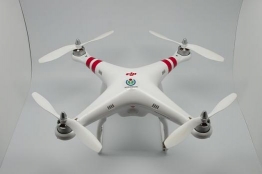
DJI Phantom DroneChemical sensors are capable of detecting and analyzing gases in order to alert us to airborn pollutants from industrial processes, smog, natural events such as volcanic eruption and even terrorist activities (hopefully before they occur). These devices can be arranged wherever we require an awareness of what the air is carrying. US embassies use air quality units to release air quality measurements, sometimes in real time - or not at all.

When there is a major event, awareness of risk conditions for first-responder units is key. This week, Popular Science covered a Connecticut fire department using a drone to identify risk conditions for fire fighters at a quarry. While there isn't much new in using remote controlled devices to minimize the risk to human lives - bomb squads and SWAT teams have used robots for some time to get a look at situations before sending in humans - the drone provided a very different look from the air.
RoboEarth: a learning community for robots?

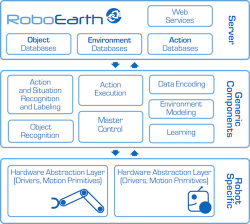
RoboEarth layers of services diagramRoboEarth is a project designed to network robots so each can add and pull information from a central repository. By sharing their "experiences", the robots can learn more quickly and access content to help them adapt to each process. The company's website provides this explanation of the online system:

"The RoboEarth Cloud Engine (also called Rapyuta) makes powerful computation available to robots. It allows robots to offload their heavy computation to secure computing environments in the cloud with minimal configuration. The Cloud Engine’s computing environments provide high bandwidth access to the RoboEarth knowledge repository enabling robots to benefit from the experience of other robots."

Can humans successfully create an artificial intelligence that wouldn't eventually turn against us?

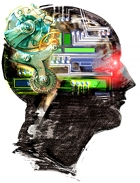
View of human head with intelligent partsIt's a good question and George Dvorsky at IO9 interviews Luke Muehlhauser, Executive Director of the Machine Intelligence Research Institute, discusses his influences and research. I think this quote sums up the importance of his work and why we should all be interested in the expectations for artificial intelligence:

I pretty quickly realized that the intelligence explosion would be the most important event in human history, and that the most important thing I could do would be to help ensure that the intelligence explosion has a positive rather than negative impact — that is, that we end up with a "Friendly" superintelligence rather than an unfriendly or indifferent superintelligence.

Asimov's 50 year predictions - and how our present influences our future views

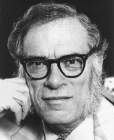
Isaac AsimovIn 1964, Isaac Asimov made 10 predictions looking forward 50 years. In 2014, the year he was predicting, Eric Mack reviews the list on CNET. While the list is interesting, I find the view of the events influencing Asimov's prediction more engaging.

Vincent Fournier's Post Natural History

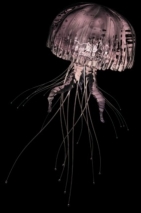
Jellyfish

Wired offers an overview of photographer Vincent Fournier's Post Natural History artwork, in which he speeds up the evolution of living organisms to incorporate technological capabilities.

These creatures come from the future—an imagined future, based loosely on current research on synthetic biology and genetic engineering. The idea is that these are living species, reprogrammed by mankind to better fit our environment as well as to adapt to new human desires.

3D printed homes in a day

3D house printerProfessor Behrokh Khoshnevis from The University of Southern California is testing a process called Contour Crafting, which is a way of 3D printing homes. It's basically a robot that extrudes concrete to provide the frame for a building. The process begins by printing hollow walls that are then filled with a solid wall of concrete for maximal structure. From there, human workers complete the home by hanging doors, installing windows, laying flooring, etc...

Check MSN's article for a better overview. Freshome's article includes Dr Khoshnevis' TEDx video.

A Robotic Petting Zoo

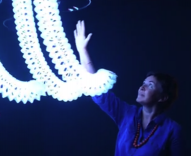
Image of robotic petting zooMinimaforms presented Petting Zoo, an interactive display designed to respond to human touch and movement. Using a Kinect camera and software designed to respond with emotions, the exhibition provided three "pets" with three different patterns of responses and a basic machine learning allows each to develop behaviors based on input from the situation.

Whirlpool reinvents the kitchen of the future, all over again

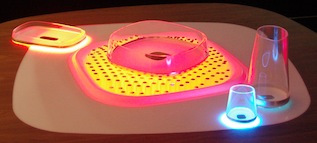
Shot of futuristic table top

Whirlpool shows off a futuristic kitchen design including a reworked cook top, responsive countertops with heating and cooling, and a new approach to refrigeration.  Honestly, it seem they've been reinventing the kitchen for so long, I'm amazed da Vinci didn't present a "Kitchen of the 17th century" when the calendar ticked to 1500.  They're always so colorful and fluid and look like they got blown into space from the Enterprise, but somehow my 2012 kitchen is still using gas fed flame and filled with stone that was ancient when da Vinci's mother was hoping for someone to invent disposable diapers.  That said, I can dream as well...

Big data, but little information?

Data viewAn interesting article on POPSCI by Lawrence Weschler on how we'll handle the vast amount of data we, as a species, are compiling at a breakneck pace.  And this is before (or perhaps just as) the algorithmic writer-bots begin absorbing and synthesizing information (news) in order to free up the need to let humans do the job of reporting on humanity.  

According to Business Insider, there is an estimated 14.3 trillion pages on the Web.  I can't find any reliable data on how fast that's growing, but this is in less than two decades and the speed at which we are adding to this is only increasing.

Pages