Can humans successfully create an artificial intelligence that wouldn't eventually turn against us?
 Printer-friendly version
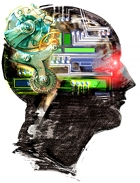 It's a good question and George Dvorsky at IO9 interviews Luke Muehlhauser, Executive Director of the Machine Intelligence Research Institute, discusses his influences and research. I think this quote sums up the importance of his work and why we should all be interested in the expectations for artificial intelligence:
I pretty quickly realized that the intelligence explosion would be the most important event in human history, and that the most important thing I could do would be to help ensure that the intelligence explosion has a positive rather than negative impact — that is, that we end up with a "Friendly" superintelligence rather than an unfriendly or indifferent superintelligence.
If you're the least bit interested in the development or accurate portrayal of an artificial intelligence, check out the article. It is well worth your time. If you're interested in some reading that explores the negative impact of unfriendly or indifferent superintelligence, here are two recommendations I've enjoyed which contain intersting human-artifiical intelligence interactions:
 Recursion by Tony Ballantyne: Looks at what happens when artificial intelligence roams free without human oversight.
 Ventus by Karl Schroeder: A world where the AI arrived first and humans need to survive.
Via IO9
 Interested in the social impact of our future advancements, Daryl developed and built Regarding Tomorrow as a platform to share and discuss our collective hopes and fears of the future. Daryl's background is in education, including graduate studies in special needs and a masters in instructional technology from UVA's Curry School of Education. He has worked as a high school teacher and has over 10 years of university experience in the US and Canada.