Vocation (occupation)

Abundance: The Future Is Better Than You Think

Book coverIn Abundance, Peter Diamandis and Steven Kotler present trends taking us towards a better future - one in which individual needs are met on a global scale. Using Maslow's Hierarchy of Needs as a foundation, they explore technology will find ways to improve efficiency by fostering cooperation, providing access to clean water, producing enough food for a planet of nine billion, and even enabling equality as limitations dissipate.

Many projections offer a future half empty. Here, we get a lesson on how our biases enable close tracking of negative trends, whether serious, global issues or personal issues threatening a comfortable ideal we would not wish to give up. Yet, data show the world is improving. As an example, Bill Gates' annual letter from this past January presents how effective support of poor economies is stabilizing population, improving health, and helping develop economies capable of supporting human rights and freedom.

The point of Abundance is that we can both thrive as a race, free of draconian measures to tame our needs, and solve our problems going forward, using new methods and technologies to empower humanity. Why settle for half empty or half full, when the future can be filled to the brim?

Social Physics

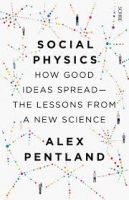
Social Physics book coverAccording to Wikipedia, Alex Pentland's areas of research include social physics, big data, and privacy. In his book, Social Physics, Pentland takes us through the benefits and issues, such as the loss of privacy, that come from comprehensive tracking. It's a short book with a deep look at how the Internet of Things and the quantified self will collect data to change the world around us and better our lives.

Focused on human behavior, the book offers a look at the range of benefits that could result from our hyperconnected world. These include idea flow to spread and advance new ideas, methods for bringing people into problem-solving scenarios to fast prototype solutions, and ways cities can take the density of its members, services, and infrastructure together to improve efficiency while providing the best living experience for the humans who call it home. At its heart, the work focuses on ways we can use data to find better methods for improving how we work together, but it also hints at the promise of an abundant future where mountains of data provide true insight to the best ways we can work together.

While that sounds promising, Pentland doesn't look at the world through rose colored glasses, but acknowledges how this data can and will impact our privacy. So he also proposes simple laws designed to allow the collection of data while protecting citizens from its inappropriate use (at least without our permission).

Social Physics is a course in a book by one of, if not THE expert in this field. Pentland offers a thorough and digestible look at the field and what it offers our future.
Radical Abundance: How a Revolution in Nanotechnology Will Change Civilization

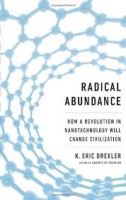
Book coverEric Drexler introduced the world to nanotechnology in his first book, Engines of Creation: The Coming Era of Nanotechnology. In his newest book, Radical Abundance, Drexler presents a range of information, informing the reader of the process of nanoscale manufacturing, current efforts and research (and hurdles), and the benefits to science, society, and the planet once we achieve the reality of nanoscale fabrication.

Drexler presents APM (atomically-precise manufacturing) as the next revolution, the first three being agriculture, industrial, and information. This revolution will be powered once we control "the molecular machinery of life (using) proteins that can fit together to form motors, sensors, structural frameworks, and catalytic devices..." By using natural systems to construct from the atomic level towards larger and more complex products, we can manufacture efficiently, using common chemical substances in place of minerals and metals acquired through ecologically damaging mining, and to create materials we cannot visualize today.

In Drexler's future, APM solves many of the societal issues that create poverty, ecological disasters, and conflict. It's an important work that gives us a future to look forward to when so many visions are broken and dystopian.

Afterparty

Afterparty book coverSet in the near future, Afterparty explores a world where psychoactive drugs are printable. All you need is a chemjet printer and an Internet connection to begin printing designer drugs on paper, which is torn up and digested for each hit. The story follows Lyda Rose, one of the five founders of Little Sprout, a group trying to find a cure for schizophrenia, a condition from which Lyda's mother suffered.

The group is successful and Numinous is ready for trials when an event changes their lives. In high enough doses, Numinous permanently alters the user's perception by imprinting a bond with whatever god they believe in, often paired with hallucinations of a holy figure to watch over or even run their lives. Lyda believed the recipe was off the market, but then someone shows up in her ward who is clearly under its effect.

Angered by this, Lyda leaves care early with plans to find the source. With help from a few friends, not all of them real, she goes on a thrilling adventure across Canada and the United States in search of answers.

Love Minus Eighty

Love Minus Eighty book coverWelcome to the early 22nd century. Social media connects the elite in real time, and the digital divide has birthed a divide so complete it has manifested a near-complete physical disconnect. And while our mortality has not been conquered, reanimation has been perfected for those who can afford it. For those who can't, there is 'freezing insurance.' And for pretty, young women who can afford insurance, but not reanimation, there is a partial life in the 'bridesicle' dating service, where if you're pretty and willing enough, a one-percenter might marry you on your deathbed before taking you home as a bride-slave.

Will McIntosh's short story "Bridesicle" won both the Hugo Award and Asimov's Reader Poll in 2010, and was a finalist for the same year's Nebula Award. Love Minus Eighty is based on the short story and a brilliant dystopian look at a future that forecasts many of today's headline issues. McIntosh offers a very engaging world where the storyline shifts between High Town and the suburbs, contrasting the have's and have-not's of the world. Looking at the social changes, it feels like McIntosh did a good job of taking some of our current systems such as social media and incoming advancements such as life-expansion and autonomous systems forward in ways that are both promising and sour to current tastes.

Will the future reduce our work hours?

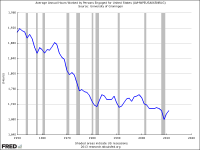
Average yearly work hours for AmericansIt's a complex issue and there are bound to be unexpected consequences. Historic data show reduced hours per American workers since 1950 when the average American workers' hours were 1,920 per year to 1700 in 2012. Averaged per week, our work week has shrunk from 37 to 33 hours per week in 60 years.

Sadly, these work hour reductions aren't spread evenly. While the work week has shrunk, it has more to do with companies reducing their full time positions to reduce benefit costs. In truth, salaried employees and specialized blue collar workers have seen an increase in their hours since the 1980's. At Salon, Sara Robinson offers a history of the 40-hour work week, including how it came about and why it is becoming more rare of late.

Providing flexible education for a robust economy

Digital classroomIn 2010, I attended a the New Media Consortium's summer conference and Peter Smith's presentation "The End of Scarcity: Can We Handle It?" Part of the presentation focused on America's current intellectual capacity and how quickly we could fall behind China and India as those nations continue to birth dozens of children for every one in America. As he mentioned in the session, in China's high schools, the top 20% outnumber America's entire class of graduating seniors. As a result, we're at risk of being outperformed based on sheer numbers - a real issue we must deal with in order to retain our place in a world economy.

Smith makes the point we must maximize every American's potential and offer a range of programs capable of providing skill mastery through easily accessible and time-flexible learning opportunities. What changes might we see to maximize opportunity? Here are two articles providing a look at the future of education and post-secondary education specifically.

Future Babble

Future Babble coverWhy do we try to predict the future? According to Dan Gardner, it's because of our human need to protect ourselves that we are constantly attempting to recognize risk before the lions, tigers and bears descend upon us. In Future Babble: Why Expert Predictions are Next to Worthless and You Can Do Better, Gardner provides historical insights on the types of futurists able to make the most reliable predictions. Guess what? Those predictions don't come from experts in a field, they come from people with a wide range of knowledge looking at trends from different angles.

Dan Abelow: The journey to our full potential

House comparisonFuturists often explain our potential consumption in the number of planets we would need if everyone lives like a Westerner with large homes, multiple cars, and a dependency on consumerism to drive the economy - the last count I read was six Earths. It's a fair assumption and a questionable habit. In fact, I believe teaching my daughter to control her consumerism will be a key asset in her future no matter where or how she lives.

As part of an ongoing series to introduce his new book, Dan Abelow introduces chapter 1.2 about the Age of Crisis, which he refers to as The Crisis of Success. He sums the crisis up very well in a single sentence:

Our growing Crisis of Success comes from who we are: Everyone wants it all, wants it now, and won’t stop.

Pages