Social Physics
 Printer-friendly version
- No explicit material
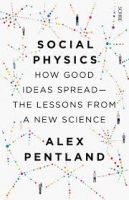 According to Wikipedia, Alex Pentland's areas of research include social physics, big data, and privacy. In his book, Social Physics, Pentland takes us through the benefits and issues, such as the loss of privacy, that come from comprehensive tracking. It's a short book with a deep look at how the Internet of Things and the quantified self will collect data to change the world around us and better our lives.
Focused on human behavior, the book offers a look at the range of benefits that could result from our hyperconnected world. These include idea flow to spread and advance new ideas, methods for bringing people into problem-solving scenarios to fast prototype solutions, and ways cities can take the density of its members, services, and infrastructure together to improve efficiency while providing the best living experience for the humans who call it home. At its heart, the work focuses on ways we can use data to find better methods for improving how we work together, but it also hints at the promise of an abundant future where mountains of data provide true insight to the best ways we can work together.
While that sounds promising, Pentland doesn't look at the world through rose colored glasses, but acknowledges how this data can and will impact our privacy. So he also proposes simple laws designed to allow the collection of data while protecting citizens from its inappropriate use (at least without our permission).
Social Physics is a course in a book by one of, if not THE expert in this field. Pentland offers a thorough and digestible look at the field and what it offers our future.
Why you should read this book
Pentland writes the future in this book, even though it isn't a work of fiction. As I read this work, I was making easy connections with how social networking and data collection have been portrayed in the news and media, but in a way that was clear and more broadly applicable.
An example is the term 'Big Data', which is used widely today. Social Physics provides a complete breakdown of the issues surrounding this new practice. In fact, if I were to identify the most important lesson of the book, at least for myself, it's one that I haven't seen discussed around the topic. My greatest takeaway is that big data isn't about sales or efficiency or granularity (though it is all of those things), it's really about human networking.
It's about the sharing and adoption of better ideas. It's that humanity is the primary focus of big data and should also be the primary benefactor. By making big data human-centric, we improve human lives around the globe. By networking humans, we humans provide the relationships necessary for 'exploration', which Pentland introduces with:
From here onward I will use the term "exploration" to refer to the use of social networks in harvesting ideas and information. Exploration is the part of the idea flow that brings new ideas into a work group or community.
To Pentland, this exploration includes three important points:
- Social learning is critical: Copying other people's successes, when combined with individual learning, is dramatically better than individual learning alone.
- Diversity is important: When everyone is going in the same direction, then it is a good bet that there isn't enough diversity in your information and ideas sources, and that you should explore further.
- Contrarians are important: When people are behaving independently of their social learning, it is likely that they have independent information and that they believe in that information enough to fight the effects of social influence.
By facilitating exploration, ideas reach all decision makers, which helps the group make better decisions by developing better ideas (and also by weeding out bad ideas). This comes about in many ways. One is by injecting ideas that break our connections to bad ideas by disproving them. Another is by helping build majority so that all members adopt better ideas. And the greatest motive is to build collective intelligence by supporting the "pooling of a diverse set of ideas from everyone, combined with an efficient winnowing process to establish a consensus..."
In the end, Social Physics is about making the connections necessary to allow these ideas to spread. Our actions when using ideas creates data. This data helps identify the most efficient and effective ideas, which in turn are disseminated through social networking. As the ideas spread, we can track their impact and then identify a new generation of ideas yet again.
There are risks and Pentland both acknowledges issues of privacy and sets the boundaries for a safe future.
A successful data-driven society must be able to guarantee that our data will not be abused-and perhaps especially that government will not abuse the power conferred by access to such fine-grain data.
To solve this issue, he provides his "New Deal on Data" - a set of three points:
- You have a right to possess your data. Regardless of what entity collects the data, the data belongs to you, and you can access your data at any time. Data collectors thus play a role akin to a bank managing the data on behalf of its customers.
- You, the data owner, must have full control over the use of your data. The terms of use must be opt-in and clearly explained in plain language. If you are not happy with a way a company uses your data, you can remove it, just as you would close your account with a bank that is not providing satisfactory service.
- You have a right to dispose or distribute your data. You have the option to have data about you destroyed or deployed elsewhere.
By providing these points, Pentland is identifying the safety we need (from entities such as Google and Facebook and even governmental units such as the NSA) to willingly hand over our lives for data mining so the outcome can benefit the greater good. As he says in his summary:
By creating social systems that are based on using big data to map detailed patterns of idea flow, we can predict how social dynamics will influence financial and government decision making, and potentially achieve great improvements in our economic and legal systems. For one thing, we can begin using the tools of social physics to improve idea flow, and so hope to improve the productivity and creative output of our societies. Dense, continuous data together with visualizations of idea flow can also give us unprecedented instrumentation of hour our policies are performing so that they can be quickly adjusted and revised as needed.
For my own summary, let me say this is the most difficult book I've ever reviewed. Pentland meshes so many ideas and topics together, I find it difficult to do an accurate job of compressing all of them into a short (missed that one, I think) review. He does such a good job of helping it flow from idea to idea, it's hard to break them apart.
But trust me, this is a powerful work with a broad lesson and will help you understand what our data can do for us in the future. Here are some additional resources that provide information on the subject, many from Pentland himself.
- The Limits of Social Engineering - MIT Technology Review
- Website for Social Physics including videos, data, and papers on the topic.
- And an hour long presentation on the topic by Dr. Pentland himself.
Topics covered
Futurists will enjoy the topics explored in the movie, including:
- The positive and personal uses of big data
- Social networking for problem solving
- Measuring why society reacts to stimuli
- Social intelligence
- Reality mining
- Using peer pressure for new idea adoption
- Privacy concerns of big data
If you enjoyed this review and intend to buy this book, please consider buying through this link.
Your overall rating:
Quality of the work (writing, art, photography, etc):
How believable?:
How original?:
Story tags (elements of how we live):
Location of story:
Years into the future:
 Interested in the social impact of our future advancements, Daryl developed and built Regarding Tomorrow as a platform to share and discuss our collective hopes and fears of the future. Daryl's background is in education, including graduate studies in special needs and a masters in instructional technology from UVA's Curry School of Education. He has worked as a high school teacher and has over 10 years of university experience in the US and Canada.