Non-fiction book

Abundance: The Future Is Better Than You Think

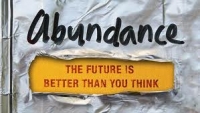
Book coverIn Abundance, Peter Diamandis and Steven Kotler present trends taking us towards a better future - one in which individual needs are met on a global scale. Using Maslow's Hierarchy of Needs as a foundation, they explore technology will find ways to improve efficiency by fostering cooperation, providing access to clean water, producing enough food for a planet of nine billion, and even enabling equality as limitations dissipate.

Many projections offer a future half empty. Here, we get a lesson on how our biases enable close tracking of negative trends, whether serious, global issues or personal issues threatening a comfortable ideal we would not wish to give up. Yet, data show the world is improving. As an example, Bill Gates' annual letter from this past January presents how effective support of poor economies is stabilizing population, improving health, and helping develop economies capable of supporting human rights and freedom.

The point of Abundance is that we can both thrive as a race, free of draconian measures to tame our needs, and solve our problems going forward, using new methods and technologies to empower humanity. Why settle for half empty or half full, when the future can be filled to the brim?

Social Physics

Social Physics book coverAccording to Wikipedia, Alex Pentland's areas of research include social physics, big data, and privacy. In his book, Social Physics, Pentland takes us through the benefits and issues, such as the loss of privacy, that come from comprehensive tracking. It's a short book with a deep look at how the Internet of Things and the quantified self will collect data to change the world around us and better our lives.

Focused on human behavior, the book offers a look at the range of benefits that could result from our hyperconnected world. These include idea flow to spread and advance new ideas, methods for bringing people into problem-solving scenarios to fast prototype solutions, and ways cities can take the density of its members, services, and infrastructure together to improve efficiency while providing the best living experience for the humans who call it home. At its heart, the work focuses on ways we can use data to find better methods for improving how we work together, but it also hints at the promise of an abundant future where mountains of data provide true insight to the best ways we can work together.

While that sounds promising, Pentland doesn't look at the world through rose colored glasses, but acknowledges how this data can and will impact our privacy. So he also proposes simple laws designed to allow the collection of data while protecting citizens from its inappropriate use (at least without our permission).

Social Physics is a course in a book by one of, if not THE expert in this field. Pentland offers a thorough and digestible look at the field and what it offers our future.
Radical Abundance: How a Revolution in Nanotechnology Will Change Civilization

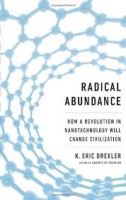
Book coverEric Drexler introduced the world to nanotechnology in his first book, Engines of Creation: The Coming Era of Nanotechnology. In his newest book, Radical Abundance, Drexler presents a range of information, informing the reader of the process of nanoscale manufacturing, current efforts and research (and hurdles), and the benefits to science, society, and the planet once we achieve the reality of nanoscale fabrication.

Drexler presents APM (atomically-precise manufacturing) as the next revolution, the first three being agriculture, industrial, and information. This revolution will be powered once we control "the molecular machinery of life (using) proteins that can fit together to form motors, sensors, structural frameworks, and catalytic devices..." By using natural systems to construct from the atomic level towards larger and more complex products, we can manufacture efficiently, using common chemical substances in place of minerals and metals acquired through ecologically damaging mining, and to create materials we cannot visualize today.

In Drexler's future, APM solves many of the societal issues that create poverty, ecological disasters, and conflict. It's an important work that gives us a future to look forward to when so many visions are broken and dystopian.

The Silent Intelligence: The Internet of Things

The Silent Intelligence book coverThe term "Internet of Things" is thrown around a lot, even used in parallel with other terms describing the same thing for a specific area of focus. Even after reading a range of articles over the last few years, I felt my understanding remained a bit vague and decided to look for a resource with depth and breadth. Kellermeit and Obodovski's The Silent Intelligence: The Internet of Things comes highly rated on Amazon (4.5 stars) and seemed more informational than application-oriented books such as McEwen and Cassimally's Designing the Internet of Things, or Robert Scoble and Shel Israel's Age of Context: Mobile, Sensors, Data and the Future of Privacy - which I plan to read as well.

Future Babble

Future Babble coverWhy do we try to predict the future? According to Dan Gardner, it's because of our human need to protect ourselves that we are constantly attempting to recognize risk before the lions, tigers and bears descend upon us. In Future Babble: Why Expert Predictions are Next to Worthless and You Can Do Better, Gardner provides historical insights on the types of futurists able to make the most reliable predictions. Guess what? Those predictions don't come from experts in a field, they come from people with a wide range of knowledge looking at trends from different angles.

2030: A Day in the Life of Tomorrow's Kids

2030 book coverSo much energy goes into the future, both preparing for it and finding ways to retail it, but there aren't many good resources for the kids who will inherit it. 2030: A Day in the Life of Tomorrow's Kids is just that - a resource to help today's kids understand a bit of what their future might hold.

It's a nice resource and at only 30 pages long, it manages to cover a wide range of material, including clothing, communications, living space, careers, our populations, housing developments, transportation, recreation and education. The final page includes a nice list of books, reports and websites the reader can access for additional information.

Tomorrow Now: Envisioning the Next 50 Years

Tomorrow Now book coverBruce Sterling has written three non-fiction books. This is his second and was published in 2003. It's a multilayered work, with seven stages (chapters) based on William Shakespeare's As You Like It, in which Jaques's monologue outlines the seven ages of man as infant, schoolboy, lover, soldier, justice, and at the end of life. Through each stage, Sterling looks at current (at the time) research and runs it out 50 years, to the middle of our century, attempting to paint a picture of how our lives will change.

The Future of the Mind: The Scientific Quest to Understand, Enhance, and Empower the Mind

Dr. Kaku provides of his new book and how our understanding of the human mind will enable some amazing feats in the near future - including the ability to record  thoughts in rats and be able to play them back into the rat's brain so the thought is relearned by the animal.