Relationships (matrimony)

An Hour with Will McIntosh

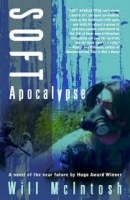
http://www.amazon.com/gp/product/159780276X/ref=as_li_tl?ie=UTF8&camp=1789&creative=390957&creativeASIN=159780276X&linkCode=as2&tag=regardtomor07-20&linkId=HTYCIYXBI2SHEYDAIf you aren't familiar with Will McIntosh, he isn't surprised.  Like many authors, Will is happy just to have a writing career and thankful for the opportunities his readers provide, even if his name isn't well known. But given the quality of his previous work and a new young adult science fiction series in development (The first novel, Burning Midnight, is scheduled for 2016), don't be surprised if you start hearing his name more often.

But you should know his short story "Bridesicle" won the Hugo Award for Best Short Story and also the Asimov's Reader Poll in 2010. It was also a finalist for the Nebula Award for Best Short Story that same year. His short version of "Soft Apocalypse" was a finalist in 2005 for both the British Science Fiction and British Fantasy Awards.

Do We Need Humans?

Robot workerThere is a lot of speculation on the technological singularity - the point at which artificial intelligence has progressed beyond human intelligence. Between AI and advanced engineering, humans could quickly become extraneous to modern society, especially from the viewpoint of those who own the robots and see extra humans as needful beings who return little to the planet.

That's a very dystopian view, but a possible outcome all the same. The February 28, 2014 episode of NPR's Ted Radio Hour offers four viewpoints on the future of humanity.

The Hyperloop is down...speculative fiction by Crave's Eric Mack

Eric Mack, from CNET's Crave, wrote a two piece story using today's news to speculate on what the futre might look like a decade or two from now. Worth a few minutes read to see what he thinks about a few things. Especially with humor like this:

With all my high-speed transport options out of commission for the day, I should be posting my own angry EEG GIF showing my brainwaves mashed up with some vintage footage from an old Dwayne Johnston flick, back before he was elected, before his groundbreaking presidency united the American and Canadian states (largely to allow for American drone fleets to better protect Arctic borders from polar pirates) and led to the annexation of Mexico, back when -- for some reason -- everyone simply called him "The Rock."

Part 1: The Hyperloop is down and I'm late for work
and part 2: Smart wig on and lightsaber packed, I visit the future.

Enjoy.

Surrogates (Graphic novel and 2009 film)

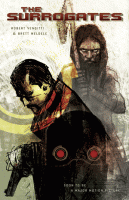
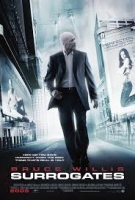
Cover of Surrogates graphic novel  Surrogates movie poster The Surrogates is a 2005 comic series that explored a future society where humans control robots from the comfort and safety of their own homes. These robots provide what appears to be perfect telepresence by connecting the owners to the outside world - without risk to their physical bodies.

The series was made into a motion picture in 2009, titled Surrogates, with a slightly altered storyline in which humans can be killed through through the Surrogate interface. In both works, investigators (police in the graphic novels and FBI agents in the film) attempt to solve a series of crimes involving attacks on surrogates, with the investigation taking them deep into societal issues between a modern world and a militant group who refuses to interact with surrogates.

They are both engaging stories exploring extreme telepresence and the positives and negatives that come with the technology. The graphic novels are thoughtful and very well written with a lot of believability. The film is science fiction as an action film, though Surrogates takes time to explore additional elements not included in the graphic novels, adding to the plot and in the background of the main storyline. It's an intelligent movie behind the gunshots and car chases.

TiMER (2010 comedy)

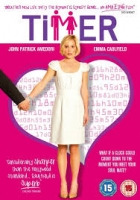
Timer movie posterWhile most science fiction uses action films to hide ways to make us think, TiMER is a relationship comedy. Set in a future where a wearable device counts down the time until the wearer is destined to meet his or her soul mate, this soft science fiction film looks at what we lose when we give too much control to a technology.

In the film, Oona (played by Emma Caulfield from Buffy the Vampire Slayer) has a TiMER that doesn't register a number - meaning her soul mate has not yet had a TiMER installed. The film explores the myriad ways the service influences how users seek, wait, and find love. It's an interesting film that is a nice break from the explosion filled dystopias Hollywood tends to produce.

River of Gods


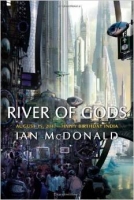
River of Gods coverIt's 2047, a hundred years after India gained independence from Britain, River of Gods is set in a country now broken into smaller nations. There hasn't been a monsoon season in years, resulting in a parched region with a Ganges trickling through Varanasi after being dammed upstream - a dam that has two nations on the edge of war.

The world is a different place in 2047. Genetic modification is everywhere, including superchildren and gender neutralizing body modifications. Artificial intelligence operates at different levels, some of them above the limits banned by international treaty. Otherwise, much of India is still poor, water is even more scarce, and the caste system carries on with only a few adjustments.

However, the Americans have found something deep in space. An object that causes a lot of questions and sends a specialist in search of her former lover. In India, someone else finds him first, someone with a strange past and who might not be completely human. Meanwhile, Mr. Nandha, one of the Krishna Cops, is hunting aeai's (artificial intelligence) with his team.

A winner of the British Science Fiction Association award and a nominee for both the Arthur C. Clarke Award and Hugo Award, River of Gods is a wild ride through a futuristic Indian culture. The complexity of the story, presenting normal human lives and emotions intertwined with decades of advancements, presents a believable backdrop against which events unfold.

Social Physics

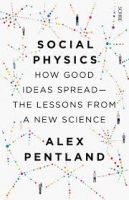
Social Physics book coverAccording to Wikipedia, Alex Pentland's areas of research include social physics, big data, and privacy. In his book, Social Physics, Pentland takes us through the benefits and issues, such as the loss of privacy, that come from comprehensive tracking. It's a short book with a deep look at how the Internet of Things and the quantified self will collect data to change the world around us and better our lives.

Focused on human behavior, the book offers a look at the range of benefits that could result from our hyperconnected world. These include idea flow to spread and advance new ideas, methods for bringing people into problem-solving scenarios to fast prototype solutions, and ways cities can take the density of its members, services, and infrastructure together to improve efficiency while providing the best living experience for the humans who call it home. At its heart, the work focuses on ways we can use data to find better methods for improving how we work together, but it also hints at the promise of an abundant future where mountains of data provide true insight to the best ways we can work together.

While that sounds promising, Pentland doesn't look at the world through rose colored glasses, but acknowledges how this data can and will impact our privacy. So he also proposes simple laws designed to allow the collection of data while protecting citizens from its inappropriate use (at least without our permission).

Social Physics is a course in a book by one of, if not THE expert in this field. Pentland offers a thorough and digestible look at the field and what it offers our future.

Her (2013)

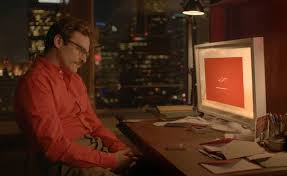
Her - setting up the computerTheodore Twombly is an introvert going through divorce. After he purchases an operating system designed to be a virtual friend, Theodore become emotionally attached to 'Samantha' and enters into a romantic relationship with her. - her being the artificial intelligence in his computer. Her follows their relationship through the typical trials most human relationships go through, with the added issues of a virtual companion who attempts to satisfy their 'lover' through a variety of emotional and romantic experiences.

At its heart, Her is a relationship film set around two very different people, one made of code, attempting to find common ground. It explores the variety of their relationship from Theodore's viewpoint, though Samantha's growth and issues are also represented throughout the story. As the story unfolds and the relationship goes through its ups and downs, we get a sense of this new and fragile pairing.

Nominated for five Academy Awards, Her won best screenplay in addition to being nominated for best picture. With a laid back, futuristic setting and a story presented through conversation and emotion, Her isn't just science fiction, it's a brilliant look at a future where artificial intelligence, and also artificial emotion, impacts the individual.

Afterparty

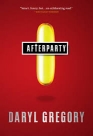
Afterparty book coverSet in the near future, Afterparty explores a world where psychoactive drugs are printable. All you need is a chemjet printer and an Internet connection to begin printing designer drugs on paper, which is torn up and digested for each hit. The story follows Lyda Rose, one of the five founders of Little Sprout, a group trying to find a cure for schizophrenia, a condition from which Lyda's mother suffered.

The group is successful and Numinous is ready for trials when an event changes their lives. In high enough doses, Numinous permanently alters the user's perception by imprinting a bond with whatever god they believe in, often paired with hallucinations of a holy figure to watch over or even run their lives. Lyda believed the recipe was off the market, but then someone shows up in her ward who is clearly under its effect.

Angered by this, Lyda leaves care early with plans to find the source. With help from a few friends, not all of them real, she goes on a thrilling adventure across Canada and the United States in search of answers.

Love Minus Eighty

Love Minus Eighty book coverWelcome to the early 22nd century. Social media connects the elite in real time, and the digital divide has birthed a divide so complete it has manifested a near-complete physical disconnect. And while our mortality has not been conquered, reanimation has been perfected for those who can afford it. For those who can't, there is 'freezing insurance.' And for pretty, young women who can afford insurance, but not reanimation, there is a partial life in the 'bridesicle' dating service, where if you're pretty and willing enough, a one-percenter might marry you on your deathbed before taking you home as a bride-slave.

Will McIntosh's short story "Bridesicle" won both the Hugo Award and Asimov's Reader Poll in 2010, and was a finalist for the same year's Nebula Award. Love Minus Eighty is based on the short story and a brilliant dystopian look at a future that forecasts many of today's headline issues. McIntosh offers a very engaging world where the storyline shifts between High Town and the suburbs, contrasting the have's and have-not's of the world. Looking at the social changes, it feels like McIntosh did a good job of taking some of our current systems such as social media and incoming advancements such as life-expansion and autonomous systems forward in ways that are both promising and sour to current tastes.

Pages