River of Gods
 Printer-friendly version
- Contains explicit material
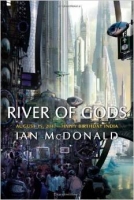 It's 2047, a hundred years after India gained independence from Britain, River of Gods is set in a country now broken into smaller nations. There hasn't been a monsoon season in years, resulting in a parched region with a Ganges trickling through Varanasi after being dammed upstream - a dam that has two nations on the edge of war.
The world is a different place in 2047. Genetic modification is everywhere, including superchildren and gender neutralizing body modifications. Artificial intelligence operates at different levels, some of them above the limits banned by international treaty. Otherwise, much of India is still poor, water is even more scarce, and the caste system carries on with only a few adjustments.
However, the Americans have found something deep in space. An object that causes a lot of questions and sends a specialist in search of her former lover. In India, someone else finds him first, someone with a strange past and who might not be completely human. Meanwhile, Mr. Nandha, one of the Krishna Cops, is hunting aeai's (artificial intelligence) with his team.
A winner of the British Science Fiction Association award and a nominee for both the Arthur C. Clarke Award and Hugo Award, River of Gods is a wild ride through a futuristic Indian culture. The complexity of the story, presenting normal human lives and emotions intertwined with decades of advancements, presents a believable backdrop against which events unfold.
Why you should read this book (many spoilers ahead)
McDonald layers so many changes into the world, but shows a master's hand by not bringing each to the forefront. Many play out in the background or only happen once, even though those single introductions change our understanding of the story's global politics and technological advancements by mid-century. There are so many elements they are hard to track, but they provide a gritty, detailed series of changes making the setting more believable.
Of the changes that do play large roles in the story, we get the normal space flight, autonomous weapons, and genetic modifications. But unlike some novels, each of these include political machinations and unforeseen consequences of their introduction to our societies.
Of the major changes, the three big ones are nutes, Brahmins, and aeais. Nutes are humans who undergo (if I completely understand it) genetic modifications and elective surgery to change their bodies into gender neutral and enhanced forms. They form a third gender that is not completely accepted by their fellow humans and possess their own society.
Brahmins are superchildren, possessing enhanced genetics that make them immune to disease and also slower in their physical aging process. Considered a new caste, these children are a choice of the parents to provide them with greater health and lifespan.
Finally, aeais, artifical intelligences, are more central to the story. Each entity is ranked on a scale with levels representing their danger. Level 1 aeai are described in this passage:
Also new, beautiful and state-of-the market is Daka's new airport, and so is its recently installed air-traffic control system. This is the reason a high-priority diplomatic transport is stacked for half an hour and then put down on a stand way on the other side of the field from the BharatAir airbus. An interface problem; the ATC computer are Level 1 aeai, with the intellect, instinct, autonomy and morals of a rabbit, which is considerably more, as one of the Bharat Times press corps comments, than the average Daka air-traffic controller.
At Level 2, aeais are more autonomous and have personality. But are they sentient? One answers that question in this passage:
“But in that case are you—as Lal Darfan—sailing pretty close to the wind? I mean, the Hamilton Acts on Artificial Intelligence…”
“The Krishna Cops? McAuley's hijras,” Lal Darfan says with venom.
“What I'm saying is, for you to say you're self-aware—sentient, as you seem to be claiming—is signing your own death warrant.”
“I'm never said I was sentient, or conscious, whatever that is. I am a level 2.8 aeai and it's done very nicely for me. I'm only claiming to be real; as real as you.”
“So you couldn't pass a Turing test?”
“Shouldn't pass a Turing test. Wouldn't pass a Turing test. Turing test, what's that prove anyway? Here, I'll give you a Turing Test. Classic set-up, two locked rooms and a badmash with an old style print-display screen. Let's put you in one room and Satnam from PR in the other—I presume it's him giving you the tour, they always give him the girls. He fancies himself a bit. The badmash with the display types in questions, you type back answers. Standard stuff. Satnam's job is to convince the badmash he's a woman and he can lie, cheat, say anything he wants to prove it. I think you can see it's not going to be that hard for him to do. So, does that make Satnam a woman then? I don't think it does; Satnam certainly doesn't think it does. How then is it any different from a computer to pass itself as sentient? Is the simulation of a thing the thing itself, or is there something unique about intelligence that it is the only thing which cannot be simulated? What does any of this prove? Only something about the nature of the Turing Test as a test, and the danger of relying on minimum information. Any aeai smart enough to pass a Turing Test is smart enough to know to fail it.”
But Level 3 is considered dangerous. Mr. Nandha, the krishna cop we watch chase down and destroy rogue AI through the book, has this to say (or think):
Americans fear these jungle places as they fear everything outside their own borders and co-opt Mr. Nandha and his kind to wage their unending war against the wild aeais, but much of Mr. Nandha admires the datarajas. They have energy and enterprise. They have pride and a name in the world. The sundarbans of Bharat and the States of Bengal, Bangalore and Mumbai, New Delhi and Hyderabad resound globally. They are the abodes of the mythical Generation Threes, aeais sentient beyond sentience, as high over human intelligences as gods.
And aeais are everywhere, piloting gunships, acting as DJs, personal assistants, virtual actors, they've infiltrated society from multiple fronts. Fear of aeai intelligence has the US pass the Hamilton Acts and enforce these for global protection. As Nandha explains:
“If I seem absorbed, distracted even, it is only because I believe this Generation Three to be the most serious threat this department has faced since its inception. If I may offer an opinion?”
“Your opinions are always valued here, Nandha,” Arora says.
“This department was established out of our government's desire to be seen to comply with the international agreement of artificial intelligence licensing. Failing to act against a Generation Three aeai could give the Americans reason to push their Awadhi allies into invasion on the grounds that Bharat is a haven for cyber-terror.”
I'll stop there on the AI quotes, as these don't give away much plot, but do explain the elements around which the plot unfolds. River of Gods is a brilliant novel, painting a future that is in the midst of upheaval at a point when some believe these new additions mean the end of humanity.
I enjoyed the book, though I found it a bit long. The first quarter or so jumps about, presenting many character views to provide a feel for the changes of the world. We see viewpoints from AI experts, physicists, government spooks, AI police, crooks, housewives, nutes, and some viewpoints from characters who are hard to describe (without giving away too much). Once you make it through the first part, it settles into a stable rhythm focused on characters that gives us love, sex, betrayal, political espionage, military upheaval, the Indian underworld, and even corporate backstabbing. It's a major work worth reading if you are interested in any of these or the topics listed below.
Topics covered
Futurists will enjoy the topics explored in the book, including:
- Artificial intelligence identified at different levels of capability and for different purposes.
- McDonald's superhuman AI development theory.
- Methods for hunting an AI.
- Genetic modification.
- Issues concerning how posthumans are accepted into society.
- Conflict resulting from water scarcity.
- Futuristic methods of war.
If you enjoyed this review and intend to buy this book, please consider buying through this link.
Your overall rating:
Quality of the work (writing, art, photography, etc):
How believable?:
How original?:
Story tags (elements of how we live):
Location of story:
Years into the future:
 Interested in the social impact of our future advancements, Daryl developed and built Regarding Tomorrow as a platform to share and discuss our collective hopes and fears of the future. Daryl's background is in education, including graduate studies in special needs and a masters in instructional technology from UVA's Curry School of Education. He has worked as a high school teacher and has over 10 years of university experience in the US and Canada.