Conflict (combat)

An Hour with Will McIntosh

http://www.amazon.com/gp/product/159780276X/ref=as_li_tl?ie=UTF8&camp=1789&creative=390957&creativeASIN=159780276X&linkCode=as2&tag=regardtomor07-20&linkId=HTYCIYXBI2SHEYDAIf you aren't familiar with Will McIntosh, he isn't surprised.  Like many authors, Will is happy just to have a writing career and thankful for the opportunities his readers provide, even if his name isn't well known. But given the quality of his previous work and a new young adult science fiction series in development (The first novel, Burning Midnight, is scheduled for 2016), don't be surprised if you start hearing his name more often.

But you should know his short story "Bridesicle" won the Hugo Award for Best Short Story and also the Asimov's Reader Poll in 2010. It was also a finalist for the Nebula Award for Best Short Story that same year. His short version of "Soft Apocalypse" was a finalist in 2005 for both the British Science Fiction and British Fantasy Awards.

I.R.I.S. - The day an AI goes rogue

A short film by Hasraf HaZ Dulull, I.R.I.S. is a military artificial intelligence with an expanded battle capacity plus strike autonomy. A short action film at heart, events unfold as the military sends in humans to attempt to regain control over the system. The script and scenes are not very informative, but do offer some nice visuals and a drone swarm I haven't seen used before.

Soft Apocalypse

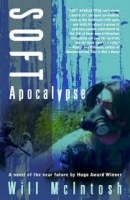
Soft Apocalypse book coverAs atmospheric carbon rises towards 450 units per million and the pitch of climatologists reach higher levels of alarm, Soft Apocalypse offers a worst-case scenario of what a slow collapse of society might look like from the inside. Where McIntosh's Bridesicle/Love Minus 80 revolved around a misuse of life-saving technology, Soft Apocalypse is an avalanche of Hell unleashed on our planet. It is futurehorror without a Freddy or Michael, where the bad guys numbered in billions around the globe. Many of them bad guys who live among us today, but who haven't been forced to show their true natures as long as the distractions of civilization keep them in check.

This story could easily be the world outside as everything unraveled in Cormac McCarthy's The Road. Watching the slow collapse of society through Jasper's narrative, we see humanity returning to its fierce roots as the veneer of civilization is slowly stripped away. Soft Apocalypse is a message you live through as you read it.

Robot concept art from Elysium by WETA concept artist Aaron Beck

Robot head from Aaron Beck's concept art for ElysiumWETA artist Aaron Beck has worked on Avatar and District 9. If you're looking for interesting artwork to stoke your imagination, he has a blog post including dozens of his concept art images for Elysium including 20 robots, 9 synthetic organisms, and a dozen weapons, along with cars, characters and fight scenes.

Surrogates (Graphic novel and 2009 film)

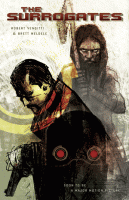
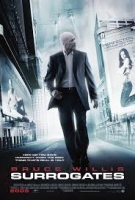
Cover of Surrogates graphic novel  Surrogates movie poster The Surrogates is a 2005 comic series that explored a future society where humans control robots from the comfort and safety of their own homes. These robots provide what appears to be perfect telepresence by connecting the owners to the outside world - without risk to their physical bodies.

The series was made into a motion picture in 2009, titled Surrogates, with a slightly altered storyline in which humans can be killed through through the Surrogate interface. In both works, investigators (police in the graphic novels and FBI agents in the film) attempt to solve a series of crimes involving attacks on surrogates, with the investigation taking them deep into societal issues between a modern world and a militant group who refuses to interact with surrogates.

They are both engaging stories exploring extreme telepresence and the positives and negatives that come with the technology. The graphic novels are thoughtful and very well written with a lot of believability. The film is science fiction as an action film, though Surrogates takes time to explore additional elements not included in the graphic novels, adding to the plot and in the background of the main storyline. It's an intelligent movie behind the gunshots and car chases.

River of Gods


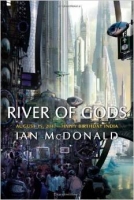
River of Gods coverIt's 2047, a hundred years after India gained independence from Britain, River of Gods is set in a country now broken into smaller nations. There hasn't been a monsoon season in years, resulting in a parched region with a Ganges trickling through Varanasi after being dammed upstream - a dam that has two nations on the edge of war.

The world is a different place in 2047. Genetic modification is everywhere, including superchildren and gender neutralizing body modifications. Artificial intelligence operates at different levels, some of them above the limits banned by international treaty. Otherwise, much of India is still poor, water is even more scarce, and the caste system carries on with only a few adjustments.

However, the Americans have found something deep in space. An object that causes a lot of questions and sends a specialist in search of her former lover. In India, someone else finds him first, someone with a strange past and who might not be completely human. Meanwhile, Mr. Nandha, one of the Krishna Cops, is hunting aeai's (artificial intelligence) with his team.

A winner of the British Science Fiction Association award and a nominee for both the Arthur C. Clarke Award and Hugo Award, River of Gods is a wild ride through a futuristic Indian culture. The complexity of the story, presenting normal human lives and emotions intertwined with decades of advancements, presents a believable backdrop against which events unfold.
Abundance: The Future Is Better Than You Think

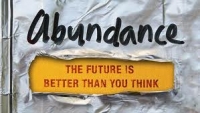
Book coverIn Abundance, Peter Diamandis and Steven Kotler present trends taking us towards a better future - one in which individual needs are met on a global scale. Using Maslow's Hierarchy of Needs as a foundation, they explore technology will find ways to improve efficiency by fostering cooperation, providing access to clean water, producing enough food for a planet of nine billion, and even enabling equality as limitations dissipate.

Many projections offer a future half empty. Here, we get a lesson on how our biases enable close tracking of negative trends, whether serious, global issues or personal issues threatening a comfortable ideal we would not wish to give up. Yet, data show the world is improving. As an example, Bill Gates' annual letter from this past January presents how effective support of poor economies is stabilizing population, improving health, and helping develop economies capable of supporting human rights and freedom.

The point of Abundance is that we can both thrive as a race, free of draconian measures to tame our needs, and solve our problems going forward, using new methods and technologies to empower humanity. Why settle for half empty or half full, when the future can be filled to the brim?

Robocop (2014)

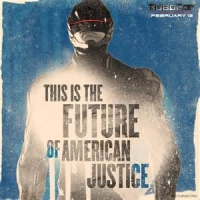
Robocop posterA future of robots replacing military and police personnel is just a matter of time. The new Robocop, a remake of the 1987 cult classic, bases the need for a cyborg police officer after mass refusal of robotic policing of US citizenry. To put a human face on the next age of police service, detective Alex Murphy is used to operate a new body that makes him a cyborg supercop and his success will provide acceptance for OmniCorp to begin selling robots to police all over America.

As part of the Robocop system Alex influences, but doesn't always control, the police software or the body it operates. The film explores his posthumanity and the line where the human ends and the robot begins - or the other way around. Seen as the Future of American Justice, Alex/Robocop works through issues at a personal level while acting as the star of the Detroit police department and a pawn of OmniCorp's need for new contracts.

I, Robot (2004)

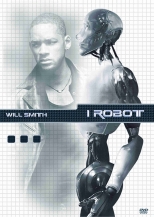
I Robot movie posterBased on the Asimov short story collection of the same name, I, Robot explores a society where humanoid robots are everywhere, doing a range of jobs, through a detective who is distrustful of robots due to a tragic accident he survived, but others didn't. As a result, when a murder happens and a robot could be responsible, the detective has to overcome doubt that a robot, required to follow the Three Laws of Robotics, could kill a human.

Another action science fiction film based on Asimov's work, the film is set in a future with many many societal changes, yet still feels incomplete. The movie is almost too clean, another clean utopia containing devoid of nature (except the cat, gotta save the cat). Yet the benefit of that sanitized environment is the way the crime stands out. Everything looks so clean and feels so efficient, you have to wonder whether any crime happens at all. For that reason, the CGI worldbuilding works for the film, though I have to wonder if a future remake with grittier writing and scenes might offer a more believable setting.

Pages