Can we find another planet comparable to Earth?
 Printer-friendly version
 Science fiction commonly presents a universe full of Earth-like planets, each capable of sustaining human life with only a few changes to terraform into a near-perfect environment. Popular Science offers an article that explain the five characteristics required to match Earth and another that presents all of the known explanets in graphics helping understand how few match these characteristics.
The characteristics are:
- Earth size, with a rocky structure...
- Near a sunlike star, but not too close...
- With liquid water...
- Biosignatures...
- ...and intelligent life.
 Though for us to repopulate another planet, it might be better if it is devoid of intelligent life. And rocky surface doesn't mean Dune, though Dune has a rocky surface. All of the inner terrestrial planets in our solar system have rocky surfaces: Mercury, Venus, Eath and Mars.
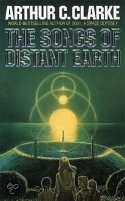
A compatible planet could look like Thalassa in Arthur C. Clarke's The Songs of Distant Earth - a planet nearly covered in water with the exception of a small set of islands where only the tallest Thallasan mountain range breaks the ocean surface.

But to understand how hard it might be to find compatible exoplanets, the second article presents several views helping to understand the planets detailed up to this point. To get a good idea, check the screen capture (visit the SciPop page for a better view) to see a graph of 3,469 exoplanets identified by each planet's radius. The line at the bottom is the radius of Earth with dots on the line representing an identified planet's expected radius. There aren't many of them by comparison, with most planets likely to be much larger.
Still, with 500 billion galaxies in the universe and estimates of how many inhabitable planets range from 17 billion to 100 billion Earth-like planets available to us. But, as this article on Extremetech points out, our fastest ever spacecraft was traveling at 43 miles per second and would take 51,000 years to reach Tau Ceti e, the closest "probably-habitable" planet at just 11.9 light years from ours.
Do you believe humanity will be able to engineer a ship capable of taking life, or just the seeds of life as in Clarke's work, to a compatible planet? If so, will we thrive there or likely die off, unable to cope with the differences we'll encounter?
 Interested in the social impact of our future advancements, Daryl developed and built Regarding Tomorrow as a platform to share and discuss our collective hopes and fears of the future. Daryl's background is in education, including graduate studies in special needs and a masters in instructional technology from UVA's Curry School of Education. He has worked as a high school teacher and has over 10 years of university experience in the US and Canada.