Curated content

Should we open the world to telepresence robots?

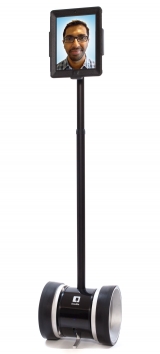
Telepresence robotEngadget reports the Tate Britain museum in London will begin offering remote controlled robotic night tours this summer. The idea is multilayered in that it presents the museum from a telepresence viewpoint and also while the museum is dark, so artwork is only viewable via light on the robot itself.

Artifact from the future: Species Design Symposium

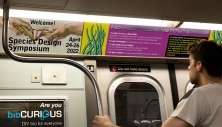
Subway view of artifact contentAnother great artifact from Institute for the Future. This time focusing on the use of genetics to create predator species capable of limiting the growth of problem species - ocean species in this scene.

It raises some good questions and brings together a few current trends: genetic engineering, failure of ecosystems as important species are wiped out to provide food (whether they are the food species or depend on disappearing habitat), and using prize money to crowd-source innovations.

The 'True Love' Bra

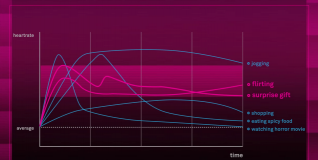
Heart rate responses to various input The Japanese lingerie manufacturer Ravijour has a new product out they call the True Love Tester bra. You can watch the video linked off the Popular Science article for their presentation of how it works, but the truly interesting detail is the graph of heart rate responses to varying stimuli - and how a company looking to market a new product uses our data.

If I understand this correctly, the bra senses the wearer's heart rate and when it "exceeds a certain value, the bra hook is unlocked automatically." A situation where a biological response can act as a trigger may be a bit part of our wearable future, but is it something we can trust or simply a gizmo to play with?

While the novelty isn't world-changing, it is an example of how our biodata can be used in different ways and how wearables can impact the world around us using our biology as a key.

Artifact from the Future: Swap spit for rides (not as bad as it sounds)

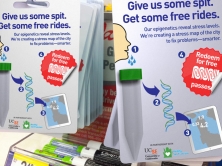
Artifact from the Future: Give Some Spit, Get a Free Ride - See more at: http://www.iftf.org/future-now/article-detail/artifact-from-the-future-give-some-spit-get-a-free-ride/#sthash.mP4l3MBI.dpuf Another IFTF artifact this week. This time offering a trade of DNA from your spit with an offer of free transportation with the purpose of identifying "toxins, the environment, even daily stressors."

It's an interesting idea and the trade of free for personal data keeps trending upwards. Just last week we read about Glow First, the non-profit arm of the Glow app where women can earn money towards fertility treatment by filling out ten months of fertility data.

How much data will we provide? How will it be stored? For how long? There are so many ways FREE can get us to give up details of our lives. Girls Gone Wild has proven how intimate details can be leveraged from a free T-shirt. So this view of the future doesn't beg questions about spit or transportation. Instead, I ask what it will take for us to become inoculated against so freely giving up our data/bodies/intimate details in return for the free of email/prizes/social media?

Tiny living space with space-saving ideas

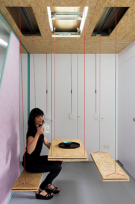
Disappearing tableBack in November, I posted about Japanese Micro-apartments and how they might offer the feeling of space confinement on long-voyage space vessels. On a happier note, Spanish architecture firm Elii takes a tiny (620 square feet) living space and redesigns it to offer useful elements such as hidden storage, disappearing eating space and maximal sunlight penetration.

Yes, there is now an app for when to keep it in your pants (or take them off)

Glow screen view Glow is an app for iOS and Android devices designed to assist women (and couples) with tracking and controlling their reproductive health by identifying their activity cycle. Founded by PayPal co-founder Max Levchin, the company offer two ways to help women or couples looking to conceive (or not).

RoboEarth: a learning community for robots?

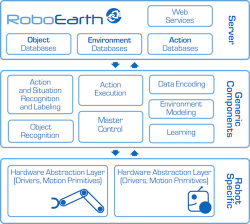
RoboEarth layers of services diagramRoboEarth is a project designed to network robots so each can add and pull information from a central repository. By sharing their "experiences", the robots can learn more quickly and access content to help them adapt to each process. The company's website provides this explanation of the online system:

"The RoboEarth Cloud Engine (also called Rapyuta) makes powerful computation available to robots. It allows robots to offload their heavy computation to secure computing environments in the cloud with minimal configuration. The Cloud Engine’s computing environments provide high bandwidth access to the RoboEarth knowledge repository enabling robots to benefit from the experience of other robots."

Ideas for dealing with rising ocean levels

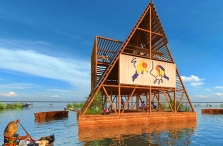
Floating school plan for NigeriaUsually, lists of interesting pictures do little more than stoke the imagination. That's great, but it's so much better when you can see some interesting ideas that could actually solve real issues. An article on Discovery.com provides a dozen ideas for dealing with rising ocean levels and also creating energy (I assume because land-based energy sources will use too much important above-water property).


Pages