Contains explicit material

Love Minus Eighty

Love Minus Eighty book coverWelcome to the early 22nd century. Social media connects the elite in real time, and the digital divide has birthed a divide so complete it has manifested a near-complete physical disconnect. And while our mortality has not been conquered, reanimation has been perfected for those who can afford it. For those who can't, there is 'freezing insurance.' And for pretty, young women who can afford insurance, but not reanimation, there is a partial life in the 'bridesicle' dating service, where if you're pretty and willing enough, a one-percenter might marry you on your deathbed before taking you home as a bride-slave.

Will McIntosh's short story "Bridesicle" won both the Hugo Award and Asimov's Reader Poll in 2010, and was a finalist for the same year's Nebula Award. Love Minus Eighty is based on the short story and a brilliant dystopian look at a future that forecasts many of today's headline issues. McIntosh offers a very engaging world where the storyline shifts between High Town and the suburbs, contrasting the have's and have-not's of the world. Looking at the social changes, it feels like McIntosh did a good job of taking some of our current systems such as social media and incoming advancements such as life-expansion and autonomous systems forward in ways that are both promising and sour to current tastes.

Song From a Forgotten Hill

Winter's Dreams book coverIn 1971, Glen Cook, an author known for his gritty fantasy novels, wrote the short story, "Song from a Forgotten Hill." Recently included in a short story collect, Winter's Dreams, "Song" is not your normal science fiction, though it is a dystopian view of a broken American landscape where the country has been through three "fires." The first is from Russian nuclear strikes on major American cities. The second is "when (black) militants burned remnants of Whiteys' cities." The third occurs when the US military's return from the war (presumably with Russia) leads to a civil contest "between whites and blacks."

In the anarchy following nuclear holocaust, Cook depicts the worst of humanity as sides are formed on American soil. Black militants strike at governmental infrastructure and then white rednecks turn back the hands of time to revisit the atrocity of slavery. In the midst of the aftermath, we find a a black protagonist, a veteran of the Vietnam war, attempting to keep his remaining family, "Four kids, the oldest fifteen, and no wife," safe and free in the wilderness: "The war killed most of the good folks. They lived where the bombs fell. The rednecks and the militants seem to be the only survivors. And now the rednecks, who had waited so long for their chance, are 'putting 'em back in their place.' There are very few of us out here in the hills. We're hunted, and running, but free."


The 'True Love' Bra

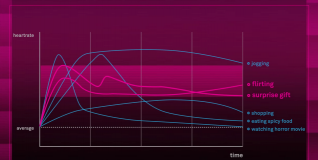
Heart rate responses to various input The Japanese lingerie manufacturer Ravijour has a new product out they call the True Love Tester bra. You can watch the video linked off the Popular Science article for their presentation of how it works, but the truly interesting detail is the graph of heart rate responses to varying stimuli - and how a company looking to market a new product uses our data.

If I understand this correctly, the bra senses the wearer's heart rate and when it "exceeds a certain value, the bra hook is unlocked automatically." A situation where a biological response can act as a trigger may be a bit part of our wearable future, but is it something we can trust or simply a gizmo to play with?

While the novelty isn't world-changing, it is an example of how our biodata can be used in different ways and how wearables can impact the world around us using our biology as a key.

Preparing for limited living quarters for deep space travel

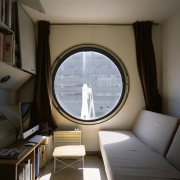
View of Japanese mini-apartmentTiny living quarters only get love in mainstream science fiction unless there is a need to present a stressful or different setting. Too much of our space travel is shown on grand ships with lounges, hotel-sized quarters and gravity. The truth is, our first manned deep-space voyages are more likely to occur on ships designed like the ISS than the USS Enterprise. Can we thrive or even manage normal levels of stress in such conditions?

Pages