No explicit material

Will the future reduce our work hours?

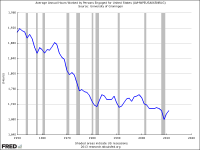
Average yearly work hours for AmericansIt's a complex issue and there are bound to be unexpected consequences. Historic data show reduced hours per American workers since 1950 when the average American workers' hours were 1,920 per year to 1700 in 2012. Averaged per week, our work week has shrunk from 37 to 33 hours per week in 60 years.

Sadly, these work hour reductions aren't spread evenly. While the work week has shrunk, it has more to do with companies reducing their full time positions to reduce benefit costs. In truth, salaried employees and specialized blue collar workers have seen an increase in their hours since the 1980's. At Salon, Sara Robinson offers a history of the 40-hour work week, including how it came about and why it is becoming more rare of late.

Surveying the future (Pew Research)

Next exit for the future signA new Pew Research Center reports on eight futuristic ideas and whether Americans view them having a positive or negative impact on society:

  • 63% don't want US airspace open to drones.
  • 53% believe devices and implants delivering constant information would have a negative impact on our lives.
  • 9% want a time machine more than any other futuristic invention.
  • 48% want to ride in a driverless car while 50% would not.
  • 8% between 30 and 49 would like a personal robot servant over any other futuristic intention.
  • 19% believe we will have weather control within the next 50 years.
  • 33% believe we will have long-term space colonies within 50 years.
  • 39% believe we will have teleportation with 50 years as well.

Providing flexible education for a robust economy

Digital classroomIn 2010, I attended a the New Media Consortium's summer conference and Peter Smith's presentation "The End of Scarcity: Can We Handle It?" Part of the presentation focused on America's current intellectual capacity and how quickly we could fall behind China and India as those nations continue to birth dozens of children for every one in America. As he mentioned in the session, in China's high schools, the top 20% outnumber America's entire class of graduating seniors. As a result, we're at risk of being outperformed based on sheer numbers - a real issue we must deal with in order to retain our place in a world economy.

Smith makes the point we must maximize every American's potential and offer a range of programs capable of providing skill mastery through easily accessible and time-flexible learning opportunities. What changes might we see to maximize opportunity? Here are two articles providing a look at the future of education and post-secondary education specifically.

Impact of technology on our youth

Toddler with a tabletThis week gives us a warning from the UK's Association of Teachers and Lecturers of young children losing core abilities as the result of tablet overuse. According to a Telegraph article:

  • Children of three and four are able to manipulate a tablet screen, but "have little or no dexterity in their fingers" after hours of this activity and are not developing the dexterity to play with building blocks.
  • "...some older children were unable to complete traditional pen and paper exams because their memory had been eroded by overexposure to screen-based technology."

Protect your DNA

A young John LennonJohn Lennon was gunned down 34 years ago. If still alive, he would be 74 years old. In 2011, one of Lennon's former housekeepers sold one of Lennon's teeth at an auction in England. The winning bid belonged to Dr. Michael Zuk, a Canadian dentist. Zuk is making headlines this week by admitting plans to have Lennon cloned from DNA remaining in the tooth and raising the resulting child as his own. It brings up many questions, including the morality of cloning someone famous and who owns your DNA once you pass on.

Will drugs + devices = superhuman intelligence?

Colorful pillsRaw intelligence is a major factor in our individual level of success - some develop more and some develop less. Whether attempting to maximize your income, research a cure for cancer or win a sporting contest, the ability to take a range of information, internalize it, and turn it into effective decisions can heavily influence whether we encounter failure or success at each task. Human intelligence is the outcome of millions of years of evolution and access to opposable thumbs has provided the ability to make the tools we have used to conquer our world. While there are proposed methods for increasing our intelligence, some individuals are using different technologies and chemicals to increase their own.

The Bourne Legacy

Bourne Legacy cover

Sometimes a great look at the future shows up in places you weren't looking. The Bourne Legacy, the sequel to the trilogy with Jeremy Renner (Hawkeye in the Avengers) taking the lead role, is a fast-paced look at posthumanism and one of the better futurist films I've watched in some time.

I'd mostly ignored Legacy, figuring it would eventually hit Netflix, but found it in the library on Blu-ray this week and picked it up. Finding some free time today, I started watching and was blown away as the back story came together piece by piece. Sometimes the best views of the future arrive in a medium other than science fiction.

Stop here if you don't want to read spoilers. But this is a great movie and worth checking out.
A world of living data - Wikipedia on steroids?

Robot wearing a press hatHumans have issues with data. Data on its own is hard to turn into information, which we can understand much more easily. Weather data is a great example, as it is both a global and local phenomenon impacting almost every day of our lives. If my phone's weather app presented data, I would receive information about regional climates as far as the Arctic and Gulf of Mexico. It would be difficult for most anyone but a meteorologist (amateur or otherwise) to make an accurate prediction using this data.

Future Babble

Future Babble coverWhy do we try to predict the future? According to Dan Gardner, it's because of our human need to protect ourselves that we are constantly attempting to recognize risk before the lions, tigers and bears descend upon us. In Future Babble: Why Expert Predictions are Next to Worthless and You Can Do Better, Gardner provides historical insights on the types of futurists able to make the most reliable predictions. Guess what? Those predictions don't come from experts in a field, they come from people with a wide range of knowledge looking at trends from different angles.

Pages