A world of living data - Wikipedia on steroids?
 Printer-friendly version
 Humans have issues with data. Data on its own is hard to turn into information, which we can understand much more easily. Weather data is a great example, as it is both a global and local phenomenon impacting almost every day of our lives. If my phone's weather app presented data, I would receive information about regional climates as far as the Arctic and Gulf of Mexico. It would be difficult for most anyone but a meteorologist (amateur or otherwise) to make an accurate prediction using this data.
Meteorologists take this data and turn it into information that is relatively trustworthy. Computer systems have now taken over this job, identifying the probability of various trends going forward. If this pattern holds forth, there is a 70% chance of sun. If this pattern changes, there is a 30% chance of rain. Thus we might get a prediction of partly cloudy with a 30% chance of rain.
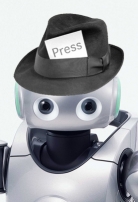
I'm sure there are many more details in the process, but it gets us close enough to the magic. Another change is happening, with computer systems beginning to take the role of reporter. A human reporter, like a meteorologist, takes the data, turns it into information, and provides context. Some do this on their own and some work with a subject matter expert to interpret the data, but the end result is a product in print, audio, video or even interactive formats designed for the typical consumer for that particular media outlet - there are different content styles for a National Geographic Kids, your local newspaper, and The Economist.
Jason Dorrier at Singularity Hub gives us a nice piece on robots writing news and a good look at the benefits and limitations of this technology as machine intelligence takes on this role. It gave me some ideas of what the future might look like and I've come to believe this advancement is necessary for the our best use of Big Data and the Internet of Things.
The movement towards Big Data means every company and organization who believes they can leverage the data they collect towards profits is grabbing as much as they can. Articles abound on the value of Big Data and how to use it, and I'm starting to see articles about how Big Data is failing as too many collectors don't know what to do with it - they haven't figured out a way to turn it into valuable information.
The Internet of Things is also about to explode on us, tracking data and providing information, whether through our networked cars, Nest thermostats or fitness wearables. There are apps to help us see the data and even make some sense of it, but these are still small sets of data. They're also relatively static, in that I can't do much with them. No queries, no sorting, no filtering - yet.
While humans and data trending apps can make data digestible or at least visual, the avalanche of data about to land on us could be overwhelming outside of the largest companies, companies that want to own our data, store our data, or sell us our data. Maybe robot writers are a blessing for the common man as we get access to similar tools available to groups and individuals much more wealthy than we are.
Let's consider combining three trends: machine intelligence writing articles (Artificial Reporters?), Big Data, and an ever growing range of charts, graphs, infographics, and the likes. As the Internet of Things infiltrates every aspect of our planet, we suddenly have access to constant streams of data. Of every stream of data. Maybe no one system has access to everything, but there are enough systems to evaluate any individual entity (individual, home, car, highway, congressman, cast of 90210, nations, weather data, birth and death reports, etc, etc, etc) that very few stones are left unturned.
I doubt there will be enough employable humans with the ability, training and interest to make sense of this mountain of data, so machines it is. Machines, after all, can complete the same task over and over again, noticing neither the tedium nor caring if their effort doesn't bear fruit. They're the perfect worker to link two things: unlimited data and visual representations of that data. We plug the data into an Artificial Reporter with access to a near endless supply of visual templates and the ability to write a contextual framework so humans can better understand the analysis. Give these AR's a process:
1. Start with a topic.
2. Identify all existing data streams applicable to that topic.
3. Compare against every visual template to see if the data meets the needs of each template, fill out viable templates and build a stack of charts, graphics, etc.
4. Create a page providing context on the value of this data and include the best visuals - make each visual live and modifiable by the user.
5. Move on to the next topic, but revisit this topic every X hours/days/months/years and rewrite as necessary.
Every topic we can imagine is alive. Think Wikipedia crossed with Google Maps - every topic is searchable, sortable and cross referenced, but each topic is also a live image of that data stream the same way our mapping apps can now provide live traffic. A Wikipedia article representing the population of the world allows you to zoom in or out and is adapted as each birth and death are input as data. If you want a place in time, just select that place in time. Each article is a "key frame" like in a video clip and provides a contextual view of that data at that time and place.
How does this change the world? These feeds can be applied to anything as a Google Glass app. Starting with an example of the information networks make available when watching a live sporting event. A player makes a shot and we see the score, his shooting percentage, maybe hear about his health history if that has been a recent issue, and we might even hear analysis on how he compares to other players.
Apply this to life and the world comes alive. Shopping experiences, family events, lawn care, travel and tourism, all of these connect to broader data as information is served up at a request. Web 3.0 isn't only a feed of information, but valuable material with context provided by Artificial Reports - and maybe Artificial Tour Guides and Artificial Shopping Agents.
Even more importantly, going back to the map comparison, is the importance of speed trap identification. Though these types of apps allow dangerous drivers to avoid detection and punishment, this idea feeds into our need to see a threat before we arrive at that location. Massive quantities of data visualized every way possible, then contextualized by a massive number of machine intelligences, each with a slightly unique way of using this data, and then set before billions of humans should provide much greater foresight than ever before.
One problem will be the creation of even more information through which we have to search to find what is meaningful to our needs. Mixing in systems such as Google Now/Siri/Cortana and we might be able to build personal data seekers, able to find the data, contextualize it, design a supporting visual resource, and serve it in the best medium for our current situation.
While it is an exciting possibility, I am also concerned how far this may push humans from the data. If our data collection is by machines, stored by machines, interpreted by machines and selected for our use by machines, how much control do we lose to machines? Keep in mind, the machines are products of large companies or by start-up which may be purchased by large companies, what type of data analysis might we receive from systems provided by news outlets controlled by groups or owners with one-sided political viewpoints?
While I hope a company like Google will allow me to set up my own reports using my own criteria, the years until that happens will include a media saturated by Artificial Reports programmed by "Fair and Balanced" news outlets such as Rupert Murdoch's Fox News or Arianna Huffington's Huffingtonpost - though it would be interesting if Huffpo let animated characters write articles for the front page of her website.
If this is the trend, are you comfortable with machines taking on this role? Should their content be reviewed by a human or just written by a human, with machine assistance? Does content written by a machine see more trustworthy or less? Post your thoughts below.
 Interested in the social impact of our future advancements, Daryl developed and built Regarding Tomorrow as a platform to share and discuss our collective hopes and fears of the future. Daryl's background is in education, including graduate studies in special needs and a masters in instructional technology from UVA's Curry School of Education. He has worked as a high school teacher and has over 10 years of university experience in the US and Canada.