Can DNA be linked to future crime?
 Printer-friendly version
 In December 2013 an assault on Sandy Hook Elementary ended with the sad deaths of twenty children and six teachers, after the killer took the life of his own mother and before taking his own. Andrew Solomon gives us a look at the killer's father (I refuse to print his name - infamy should not be gifted on a killer) and the fall out in his life a little over a year after the shootings. It's a grim article full of pain and remorse, but the paragraph that caught my eye was:
Scientists are sequencing (his) DNA to see if they can find anomalies that might explain what was broken in him. And yet, if someone has committed heinous crimes and is then found to have bad genes or a neurological abnormality, should we presume that biology compelled him? It’s a circular argument that conflates what describes a phenomenon and what causes it. Everything in our minds is encoded in neural architecture, and if scanning technologies advance far enough we’ll see physiological evidence of a college education, a failed love affair, religious faith. Will such knowledge also bring deeper understanding?
Nature vs Nurture is an old debate. Did a person turn out this way due to genetic predisposition or from their upbringing? Children in war torn parts of the world become killers before they reach their teen years. This isn't due to genetics, this is due to their surroundings. While some may take to violence more than others, it's pretty clear the primary influence is one of Nurture and not due to some genetic flaw.
What we're really looking for is the violent behavior created by the wolf among the sheep. The Menendez brothers turned on their parents while living what appears to have been a good life in Beverly Hills. What causes individuals to change into predators, both able and willing to kill strangers or loved ones? Can a genetic predisposition be proven? If so, what do we do when we can identify someone before they turn violent?
The field of eugenics has a rich and sad history of attempts to prove the superiority or inferiority of genetic material. Too many scientists working in this field have attempted to use race or skull measurements (heavy jaw or sloped forehead) to prove inherited traits. The links were non-existent to weak and rarely objective science. Modern DNA advancements are changing all of this.
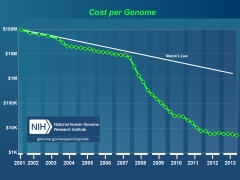 13 years ago, sequencing someone's DNA was astoundingly expensive. Since 2001, the cost has dropped from 100 million dollars to several thousand. The price at which someone might choose to have their DNA sequenced to watch for health risks has been identified as the "$1,000 genome" and prizes have been offered and awarded on the path to this entry point. In January of this year, Illumina began offering their HiSeq X Ten scanners for sequencing DNA at $1000.
Coupling this with non-invasive prenatal testing and attempts to identify the best embryo for natural IQ levels and we are clearly in the age of genetic awareness and moving into the age of genetic control. Regardless of the views on embryo shopping, it is an attempt to identify better traits to potentially produce a happier, healthier and more capable child. The same will be said of gene therapy when it is available and able to "correct" genetic disease before birth. From a parental standpoint, this would provide a child more likely to succeed. The same can be said from a social standpoint - higher intelligence and other factors could provide a stronger and safer civilization. It might not just be the wealthy countries, as Uzbekistan is planning genetic testing for Olympic level giftedness in order to cut down on the costs of training Olympic hopefuls. Could the genetic engineering of an Olympic athlete be far behind?
Getting back to violent behavior, what happens if your genes can prove you are more likely to act with murderous intent? Genetic sequencing service 23andme uses the latest research to identify a member's chance of illness against the population average - some are higher and some are lower. They also attempt to identify whether inheritable disease traits are present and how many are present when multiple copies are required for a condition to be develop. If geneticists can prove a link to violent behavior, would a service such as this include a section showing a likelihood to commit rape, child molestation, robbery or murder in your lifetime?
Genetic evidence and testing is no longer limited to the realm of science fiction. In 2009, an Italian court reduced the murder sentence of Abdelmalek Bayout due to genetic mental illness. Last year, neuroscientist Kent Kiehl of the Mind Research Network published a study showing how an MRI scan can show whether an inmate has enough impulse control to refrain from committing a felony offense within four years of release from prison. Neither the verdict nor study support proof of genetic mental illness (I suppose the brain region could be underdeveloped or damaged, but I suspect genetics would be the key) at this time. But it does show there is both interest and action around this subject - one man has some of his punishment forgiven and research may prove which paroled inmates should be watched more closely or even forced to remain in some limited custody.
Genetic advancement seems to be coming together quickly and will force a few hard questions: If science can prove a genetic predisposition and that eradicating this gene would cut violent crime in half, would you be comfortable with a eugenic program designed to keep violent criminals from breeding? Would you find a program where children had their DNA modified in the womb to eradicate this genetic information? At some point society will need to decide whether to put greater weight on freedom of choice or protecting the masses.
 Interested in the social impact of our future advancements, Daryl developed and built Regarding Tomorrow as a platform to share and discuss our collective hopes and fears of the future. Daryl's background is in education, including graduate studies in special needs and a masters in instructional technology from UVA's Curry School of Education. He has worked as a high school teacher and has over 10 years of university experience in the US and Canada.