How economic warfare drives ecological destruction
 Printer-friendly version
Too many future visionaries depict a future full of clean energy and cleaner air. It's as if our need for clean air makes us willing to ignore the development and natural resource costs associated with powering all of these high-energy devices we keep adding to our lives. I'm beginning to believe most of us have certain fears which keep us from crossing a line where everything crashes into a horrific vision where every breath has a painful consequence.
When fiction does look at a trashed planet, it usually blames it on general greed. The kind of greed that just makes mankind want more, even when they have too much. Or they blame it on corporations, which is sort of the same thing. Sometimes, they're kind and blame it on some near-cataclysmic event or nuclear war. Nice of them to absolve us of the greed or blame it on terroist nations.
I think the gigantic elephant in the room we so often ignore is the development of economy to wield the power of economy. In America, we see the results of political polarization between business and ecology. I'm not certain how it came about, but the two sides are certainly at dire odds. My suspicion is the lifespan of the board of directors and stock holders of major energy corporations (and others) and how that forces a need for short term payoff in place of long term investment. The demand of greed that pushes the plans for natural gas extraction from a patient and ecologically manageable process returning Y% return on investment into fracking in order to get a return of Yx2 or x3 or x10% and damaging ecosystems and waterways with these poor practices, just so Dick and Jane can retire a few years early.
Consider how much we allow business, especially the business of energy, to contaminate our country. Fracking, oil spills, housing of partially spent nuclear fuel, heavy metals released into waterways during extraction or into the air through the burning of energy sources, etc... Why? Because energy, like roads, taxes and hourly wages, is common to every aspect of work and life. Except for in a few rare instances, nearly every business and home requires energy that creates pollution.
If we want cleaner energy, why not increase the cost of energy and provide cleaner extraction and/or creation? Because increased energy costs slow the economy. America, and a few other countries, have benefited greatly from artificially low petroleum and an abundance of native natural resources. It's part of what has given America an edge on the world market. Even as manufacturing has moved overseas, we've managed to maintain and create opportunities by providing consistently cheaper energy then our direct competitors in Europe and Asia. A strong economy means more investment means more tax base means a stronger military and more money to wield abroad.
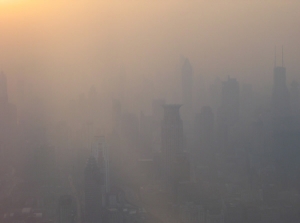
What does this have to do with the future? Let's look at China as an example. Next Big Future has an article on how much coal China will use going forward - From a reported 3.65 billion tons in 2013 to 4.8 billion tons in 2020. That's a 32% increase in the use of a very dirty energy source. Through this process, they will release 70,000 tons of mercury into the air as microscopic contaminants. That's just the mercury and doesn't take into consideration other elements which can cause major illness. Considering a few Chinese mega-cities are suffering from so much air pollution there are days when the contaminants are actually off the charts, if only because equipment designed to measure the parts per million is often limited to 755, and PM2.5 particles (identified as a cause of asthma, bronchitis, heart disease and lung cancer) are considered dangerous above 20 and hazardous above 300. What are the levels today?
Now ask this question: why would China pollute the air of 15 million Chinese citizens (in just one city, that doesn't count how many Chinese live in the region) with coal smog? Because the energy provided by those coal plants is the energy that drives the growing Chinese economy. Without energy, businesses encounter brownouts and blackouts limiting and even destroying the work of many hours of effort. China, it would seem, is willing to keep the coal plants burning and shift to roof sprinklers to cleanse city air in place of limiting smog production and protecting its citizens. Please note this is not limited to China, America has its fair share as well.
 You've hung in this long, so let me get to the point. As global conflict between different countries has decreased to historically low levels (graph from the Center for Systemic Peace), the ability to leverage economic power is the new warfare as today's superpowers, such as China and the US, can war with smaller, less capable countries, but cannot risk outright war with each other. As a result, supply and demand of key resources rules the globe and the players with the most to spend can buy or influence the most, driving up costs for less wealthy countries or possibly blocking them from more efficient technologies. Some countries are small and wealthy and homogeneous enough they can step out of the power race - or at least try. Denmark is a good example of this, with plans to become fossil fuel free by 2050 by moving to 100% internally created renewable energy.
So when we look to the future of ecological issues such as water and air quality, we need to keep in mind the only real solution is a balancing of economic power throughout the world. It isn't just old technologies that are causing the pollution. It isn't corporate greed or little Johnny wanting an XBox AND Playstation. It's about economic growth and the loss of power when your economy flatlines into deflation as unemployment skyrockets. It takes so long to build out of a stagnant economy, and to pay off the costs of doing so, that every country with power will lie, cheat, steal or war on another in order to maintain access to the resources they identify as necessary for a strong future - or at least strong now.
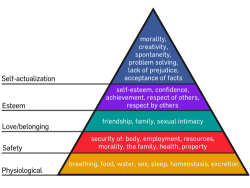 As much as we want to experience a future where our surroundings are clean and safe and relatively relaxed, the realization is that we'll likely only reach that point when nearly every human on the planet has reached a minimal life quality, one where they might be able to enjoy all the levels of Maslow's hierarchy of needs.
If and when we can deal with cultural greed and/or a desire to see a cultural enemy ground into dust, there could be a global shift towards long-term trends to limit industrial impact on the planet. Until that time, countries will continue to choose or be forced into very poor short-term practices requiring superfund cleansing. Because, as you see at the top of the pyramid, the three key elements required to reach a balanced view of the future, and to agree and implement best practices, are morality, problem solving and acceptance of facts. Without those, we create too many opportunities for violent groups like Al-Qaeda to prey on individuals in resource poor regions of the world.
 Interested in the social impact of our future advancements, Daryl developed and built Regarding Tomorrow as a platform to share and discuss our collective hopes and fears of the future. Daryl's background is in education, including graduate studies in special needs and a masters in instructional technology from UVA's Curry School of Education. He has worked as a high school teacher and has over 10 years of university experience in the US and Canada.