Will specialized artificial intelligence be kickstarted from a learning perspective?
 Printer-friendly version
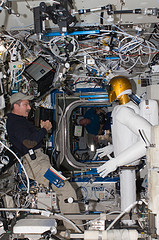 Many highly intelligent humans predict highly intelligent robots as soon as researchers find the programming and/or hardware to make it work. Theories about the technological singularity, the point at which artificial intelligence surpasses human intelligence, are supported by notable figures such as Ray Kurzweil and Vernor Vinge. It's a very attractive advancement, one in which intelligent systems can help move humanity forward faster than we ourselves are capable of managing. Coupling artificial intelligence with robotics would provide devices capable of not only responding to human need, but identifying human need in real time or even in advance of the need - and not only based on human trends, but on the needs of an individual human.
As an aside, we should also note the Terminator series turns artificial intelligence into Skynet and nearly indestructible robots with time travel capabilities. A far cry from helpful butler-bots, life-saving surgical-bots, and wiggly sex-bots.
This past week, Reuters reported on 'RoboDoc', a surgical robot based on Robonaut - a humanoid robot NASA is using for a variety of different functions. Designed to use the same tools and to work in spaces designed for humans, the Robonaut will see development for an ever growing range of activities.
And that's the issue, it needs to be developed or remote controlled for most functions, especially advanced functions like surgery. Right now, the robot is not capable of performing surgery and only acts as a telemedicine tool for a surgeon on Earth.
After reading and watching these, two thoughts struck at the same time. Let's start with the first: Can a robot learn while functioning as a tool for a surgeon? Becoming a surgeon takes over a decade of schooling and on the job training. Could a machine intelligence, observing and databasing technique whenever a human performs telemedicine, learn through each event? Can we create a robot which benefits from apprenticeship?
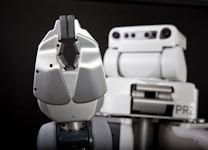 Willow Garage is developing the PR2 personal robot as an open platform system designed to learn by using humans as teachers who perform a task until the robot learns the task and, even more importantly, learns it in enough contexts to develop flexibility of application.
It was at this point I dove into my educational psychology background and Howard Gardner's theory of multiple intelligence. Gardner has identified nine unique intelligences identifiable in both humans and nature. They are:
- Musical–rhythmic and harmonic
- Visual–spatial
- Verbal–linguistic
- Logical–mathematical
- Bodily–kinesthetic
- Interpersonal
- Intrapersonal
- Naturalistic
- Existential
Some of these are probably (I'm not a programmer or AI expert) easily programmed, including visual-spacial, logical-mathematical and verbal-linguistic, at least as far as grammatically correct communication goes - poetry, word-play and dirty limericks would be more specialized. Musical, bodily-kinesthetic and naturalistic might be faked through well written code. Two of the more difficult intelligences might include interpersonal and existential. I would believe an argument that intrapersonal is the magic that makes Pinocchio a real boy.
Which brings me back to my original question:
- Will specialized artificial intelligence be kickstarted from a learning perspective?
- Could the development of individual intelligences be advanced by watching humans displaying their expertise?
- Or, would it be better to focus on learning specific techniques such as surgery?
While many futurists look towards the singularity, I wonder if the most important event will be a robot capable of receiving instruction and correction from average consumers. As long as robotic capability is advanced via free updates or expensive upgrades, a robots abilities remain in the hands of coders.
Here's my question for you: When personal robots come on the market, do you want one that has an 'app for that' or would you prefer a system capable of learning as many skills as you have the knowledge and patience to teach it?
 Interested in the social impact of our future advancements, Daryl developed and built Regarding Tomorrow as a platform to share and discuss our collective hopes and fears of the future. Daryl's background is in education, including graduate studies in special needs and a masters in instructional technology from UVA's Curry School of Education. He has worked as a high school teacher and has over 10 years of university experience in the US and Canada.