Will we allow automated robotic law enforcement?
 Printer-friendly version
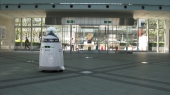 Automated law enforcement would offer a network of systems capable of identifying a crime and gathering enough information on the law-breaker for human officers to identify and consider charges. This is a hot topic issue that will become hotter as technologies merge towards the point where companies will attempt to retail robotic systems to augment human police forces.
Given the important duties human police officers provide, why would governments consider replacing them or spending money to augment existing systems? There are four reasons I can quickly identify. The first is the ability to offer police presence in more places or angles (from the sky or water) or over longer durations (days at a time) than a human force can offer. Second is the ability for robots to engage violent criminals while human police remain under cover, monitoring the scene. Third, there is the ability of networked machine intelligence to identify external information in real-time and to make connections a human might not be capable of making (though humans will also be able to make connections machine intelligence cannot). Last, is the ability for management and review boards to watch human police in action (both to protect civilians and also police officers following appropriate methods), providing important information of aggressive police behavior in real-time.
Where you've seen it - Almost Human (5 recent episodes on Hulu), set in 2048, has two types of robots:
- The older DRN series, designed to be more human - both cosmetically and emotionally.
- The newer MX series, designed without emotion in order to remove certain issues identified with the DRN series.
- Check out the latest episode - Unbound - in which a third type of android is presented:
In Minority Report, the spider robots swarm to locate a person of interest. In Elysium, robots act as police and security guards to maintain the peace and protect their owners. The movies and television are full of robotic police of all shapes and sizes, many with human forms or at least human likenesses.
My likely scenario - Whatever shape they take, it will be a strange ride when they arrive. In America, the racial stress between minorities and the police is high and the numbers show very high rates of charges and guilty verdicts against black male youths. The ongoing debate stems around changes to the system that offer equality to all races.
Objectivity is a fragile and sparse thing when humans are involved, so objective systems will be attempted via machine. Machine intelligence could be harnessed to offer this objectivity. If coded poorly, these systems could be just as harsh and focus on smaller details than humans might. Robots could, for example, be programmed to shoot anyone with green eyes or a limp. The upside of using machine intelligence could be the ability to demand internal data via discovery in a case where racism, sexism or other discriminatory practices are perceived. I would assume, though I am not an expert in law, that a robot cannot claim the 5th amendment on the stand and any internal processing can be exposed during trial.
When will they get here? They're real and they're already here. National Geographic has a great article on how drones are coming to home from war and how they'll be used in civilian affairs. While some robots may be given humanoid designs in order to work around humans, most will look very different such as disk-shaped drones or video cameras and mobile sensor suites dressed as:
- insects
- snakes
- or birds
As for a robot that might offer a visible presence for peace of mind, crime deterrence, and crowd control, Knightscope is developing the K5 unit capable of optical character recognition, omnidirectional and thermal imaging, audio recording, ultrasonic detection, infrared, radar and lidar sensors and even air quality sensors.
While the K5 is a designed to act as a patrol unit, the TeleBot was designed by a group of undergraduate students at Florida International University to provide a telepresence police robot able to be used by disabled police officers - real human police veterans able to move in the field and interact with civilians.
It remains to be decided how far legislation will allow automated law enforcement to develop and how quickly we they will arrive. There are a few questions we should ask ourselves and please add your thoughts below.
- Would you be comfortable with police robots in public places, scanning your face and other data about you?
- Would you be comfortable with autonomous robots able to force a suspect to remain in place until human officers could arrive?
- Finally, would you be comfortable with police robots allowed to fire on a violent offender even if the rounds were designed to incapacitate, but could kill in rare instances?
There will be a lot of questions asked as we advance into the future. What are your thoughts?
 Interested in the social impact of our future advancements, Daryl developed and built Regarding Tomorrow as a platform to share and discuss our collective hopes and fears of the future. Daryl's background is in education, including graduate studies in special needs and a masters in instructional technology from UVA's Curry School of Education. He has worked as a high school teacher and has over 10 years of university experience in the US and Canada.