In an alien solar system
Artifact from the Future: Swap spit for rides (not as bad as it sounds)

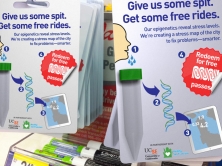
Artifact from the Future: Give Some Spit, Get a Free Ride - See more at: http://www.iftf.org/future-now/article-detail/artifact-from-the-future-give-some-spit-get-a-free-ride/#sthash.mP4l3MBI.dpuf Another IFTF artifact this week. This time offering a trade of DNA from your spit with an offer of free transportation with the purpose of identifying "toxins, the environment, even daily stressors."

It's an interesting idea and the trade of free for personal data keeps trending upwards. Just last week we read about Glow First, the non-profit arm of the Glow app where women can earn money towards fertility treatment by filling out ten months of fertility data.

How much data will we provide? How will it be stored? For how long? There are so many ways FREE can get us to give up details of our lives. Girls Gone Wild has proven how intimate details can be leveraged from a free T-shirt. So this view of the future doesn't beg questions about spit or transportation. Instead, I ask what it will take for us to become inoculated against so freely giving up our data/bodies/intimate details in return for the free of email/prizes/social media?

Owning a mobile phone makes you intimately trackable

Dear subscriber, you are registered as a participant in a mass disturbance.

This was the content of a text message received by cell phone carrying protestors in Kiev by the Ukranian government. Using mobile technologies, the government was able to identify all of the phones in certain areas and target them with this warning. It's a message that lets the carrier of the phone know they, or the phone owner, has been identified by private records as participating in the protests - or at least being in the vicinity.

Nanoribbon electricity generation from human organs

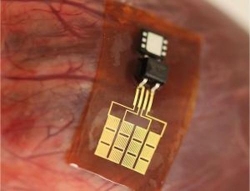
Nanoribbon on human organResearchers at the University of Illinois-Champaign have created a new flexible technology, a nanoribbon, that attaches to human organs and is capable of generating electricity as the organ moves. The current technology is focused on providing power for pacemakers so long term use of these devices could require less surgeries and also be less intrusive in the body.

The other half of the breakthrough is the ability to generate up to 8 volts of electricity from a single device embedded in the body, enough energy to power low-energy devices as long as the nanoribbon (and body) continue to function. Looking long-term, this makes it possible to go past the wearables marked into embedded sensors, monitors and even controllers (OH MY!).

Tiny living space with space-saving ideas

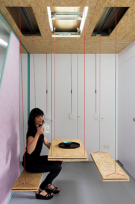
Disappearing tableBack in November, I posted about Japanese Micro-apartments and how they might offer the feeling of space confinement on long-voyage space vessels. On a happier note, Spanish architecture firm Elii takes a tiny (620 square feet) living space and redesigns it to offer useful elements such as hidden storage, disappearing eating space and maximal sunlight penetration.

RoboEarth: a learning community for robots?

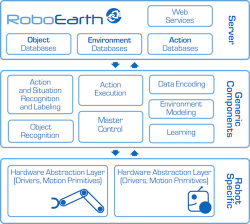
RoboEarth layers of services diagramRoboEarth is a project designed to network robots so each can add and pull information from a central repository. By sharing their "experiences", the robots can learn more quickly and access content to help them adapt to each process. The company's website provides this explanation of the online system:

"The RoboEarth Cloud Engine (also called Rapyuta) makes powerful computation available to robots. It allows robots to offload their heavy computation to secure computing environments in the cloud with minimal configuration. The Cloud Engine’s computing environments provide high bandwidth access to the RoboEarth knowledge repository enabling robots to benefit from the experience of other robots."

Can humans successfully create an artificial intelligence that wouldn't eventually turn against us?

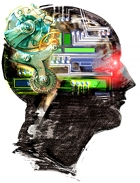
View of human head with intelligent partsIt's a good question and George Dvorsky at IO9 interviews Luke Muehlhauser, Executive Director of the Machine Intelligence Research Institute, discusses his influences and research. I think this quote sums up the importance of his work and why we should all be interested in the expectations for artificial intelligence:

I pretty quickly realized that the intelligence explosion would be the most important event in human history, and that the most important thing I could do would be to help ensure that the intelligence explosion has a positive rather than negative impact — that is, that we end up with a "Friendly" superintelligence rather than an unfriendly or indifferent superintelligence.

Hershey supporting 3D systems to print confections

Chocolate heart3D Systems previously announced products to print your own food. This week, The Hershey Company announced a multi-year partnership with the device maker to develop new ways of bringing 3D printed foodstuffs to market. Hershey is the first major food company to officially announce an interest in 3D printed foods.

Via The Verge


The future of privacy: the necessary data or a march towards a future of corporatocracy?

Prism logoThe combination of governmental and corporate data tracking are enabling outside entities to track increasingly granular details about our lives and interactions. Most of the reasons offer positives and are focused on protecting citizens or providing services we find useful. In order to do these jobs more efficiently, inroads to more data are critical in order to query across enough channels to create accurate connections such as identifying a terrorist organization's leader or helping us make certain we get enough exercise per day.

Changes towards equality creating a better future

Our march into tomorrow keeps making for better todays. Here are vidoes of three important technologies providing individuals with physical limitations the opportunity to experience and interact with the world around them.

What is Tek RMD - 9:26 long - from Matia Robotics

Read the full article for additional videos.

Increasingly inexpensive telepresence aims at the home

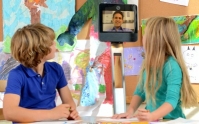
Beam+ telepresence device with two childrenSuitable Technologies has announced a telepresence robot, the Beam+, for just under $2000 (pre-order for $995). The device offers a 10-inch screen using two cameras and 4 microphones for video teleconferencing, which is build onto a stalk and moved about by a three wheeled based controlled by the "visitor" through an application on the their end.


Pages