Interface (tech control)

River of Gods


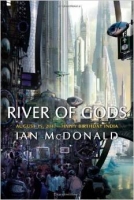
River of Gods coverIt's 2047, a hundred years after India gained independence from Britain, River of Gods is set in a country now broken into smaller nations. There hasn't been a monsoon season in years, resulting in a parched region with a Ganges trickling through Varanasi after being dammed upstream - a dam that has two nations on the edge of war.

The world is a different place in 2047. Genetic modification is everywhere, including superchildren and gender neutralizing body modifications. Artificial intelligence operates at different levels, some of them above the limits banned by international treaty. Otherwise, much of India is still poor, water is even more scarce, and the caste system carries on with only a few adjustments.

However, the Americans have found something deep in space. An object that causes a lot of questions and sends a specialist in search of her former lover. In India, someone else finds him first, someone with a strange past and who might not be completely human. Meanwhile, Mr. Nandha, one of the Krishna Cops, is hunting aeai's (artificial intelligence) with his team.

A winner of the British Science Fiction Association award and a nominee for both the Arthur C. Clarke Award and Hugo Award, River of Gods is a wild ride through a futuristic Indian culture. The complexity of the story, presenting normal human lives and emotions intertwined with decades of advancements, presents a believable backdrop against which events unfold.
Abundance: The Future Is Better Than You Think

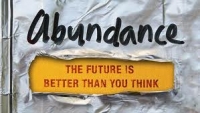
Book coverIn Abundance, Peter Diamandis and Steven Kotler present trends taking us towards a better future - one in which individual needs are met on a global scale. Using Maslow's Hierarchy of Needs as a foundation, they explore technology will find ways to improve efficiency by fostering cooperation, providing access to clean water, producing enough food for a planet of nine billion, and even enabling equality as limitations dissipate.

Many projections offer a future half empty. Here, we get a lesson on how our biases enable close tracking of negative trends, whether serious, global issues or personal issues threatening a comfortable ideal we would not wish to give up. Yet, data show the world is improving. As an example, Bill Gates' annual letter from this past January presents how effective support of poor economies is stabilizing population, improving health, and helping develop economies capable of supporting human rights and freedom.

The point of Abundance is that we can both thrive as a race, free of draconian measures to tame our needs, and solve our problems going forward, using new methods and technologies to empower humanity. Why settle for half empty or half full, when the future can be filled to the brim?

Social Physics

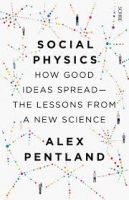
Social Physics book coverAccording to Wikipedia, Alex Pentland's areas of research include social physics, big data, and privacy. In his book, Social Physics, Pentland takes us through the benefits and issues, such as the loss of privacy, that come from comprehensive tracking. It's a short book with a deep look at how the Internet of Things and the quantified self will collect data to change the world around us and better our lives.

Focused on human behavior, the book offers a look at the range of benefits that could result from our hyperconnected world. These include idea flow to spread and advance new ideas, methods for bringing people into problem-solving scenarios to fast prototype solutions, and ways cities can take the density of its members, services, and infrastructure together to improve efficiency while providing the best living experience for the humans who call it home. At its heart, the work focuses on ways we can use data to find better methods for improving how we work together, but it also hints at the promise of an abundant future where mountains of data provide true insight to the best ways we can work together.

While that sounds promising, Pentland doesn't look at the world through rose colored glasses, but acknowledges how this data can and will impact our privacy. So he also proposes simple laws designed to allow the collection of data while protecting citizens from its inappropriate use (at least without our permission).

Social Physics is a course in a book by one of, if not THE expert in this field. Pentland offers a thorough and digestible look at the field and what it offers our future.

Robocop (2014)

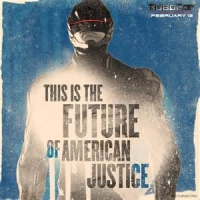
Robocop posterA future of robots replacing military and police personnel is just a matter of time. The new Robocop, a remake of the 1987 cult classic, bases the need for a cyborg police officer after mass refusal of robotic policing of US citizenry. To put a human face on the next age of police service, detective Alex Murphy is used to operate a new body that makes him a cyborg supercop and his success will provide acceptance for OmniCorp to begin selling robots to police all over America.

As part of the Robocop system Alex influences, but doesn't always control, the police software or the body it operates. The film explores his posthumanity and the line where the human ends and the robot begins - or the other way around. Seen as the Future of American Justice, Alex/Robocop works through issues at a personal level while acting as the star of the Detroit police department and a pawn of OmniCorp's need for new contracts.

Her (2013)

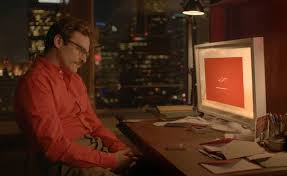
Her - setting up the computerTheodore Twombly is an introvert going through divorce. After he purchases an operating system designed to be a virtual friend, Theodore become emotionally attached to 'Samantha' and enters into a romantic relationship with her. - her being the artificial intelligence in his computer. Her follows their relationship through the typical trials most human relationships go through, with the added issues of a virtual companion who attempts to satisfy their 'lover' through a variety of emotional and romantic experiences.

At its heart, Her is a relationship film set around two very different people, one made of code, attempting to find common ground. It explores the variety of their relationship from Theodore's viewpoint, though Samantha's growth and issues are also represented throughout the story. As the story unfolds and the relationship goes through its ups and downs, we get a sense of this new and fragile pairing.

Nominated for five Academy Awards, Her won best screenplay in addition to being nominated for best picture. With a laid back, futuristic setting and a story presented through conversation and emotion, Her isn't just science fiction, it's a brilliant look at a future where artificial intelligence, and also artificial emotion, impacts the individual.

Radical Abundance: How a Revolution in Nanotechnology Will Change Civilization

Book coverEric Drexler introduced the world to nanotechnology in his first book, Engines of Creation: The Coming Era of Nanotechnology. In his newest book, Radical Abundance, Drexler presents a range of information, informing the reader of the process of nanoscale manufacturing, current efforts and research (and hurdles), and the benefits to science, society, and the planet once we achieve the reality of nanoscale fabrication.

Drexler presents APM (atomically-precise manufacturing) as the next revolution, the first three being agriculture, industrial, and information. This revolution will be powered once we control "the molecular machinery of life (using) proteins that can fit together to form motors, sensors, structural frameworks, and catalytic devices..." By using natural systems to construct from the atomic level towards larger and more complex products, we can manufacture efficiently, using common chemical substances in place of minerals and metals acquired through ecologically damaging mining, and to create materials we cannot visualize today.

In Drexler's future, APM solves many of the societal issues that create poverty, ecological disasters, and conflict. It's an important work that gives us a future to look forward to when so many visions are broken and dystopian.

Minority Report (2002)

Film posterBased on "The Minority Report," a short story by Philip K. Dick, this film explores the issue of preventing crime before it occurs. The PreCrime division, a special unit set in Washington, D.C., uses three individuals who possess the ability to foresee murders before they occur. When each case is identified, including the victim, the perpetrator, and the time, the PreCrime police use recorded visuals from the "precog's" visions to identify the location and foil the crime before it happens.

While the division has had great success and is considered perfect, the film focuses on what happens if these visions are not 100% reliable. Especially when the perpetrators are arrested and imprisoned when they were not allowed to actually commit the crime.

Gravity (2013 film)

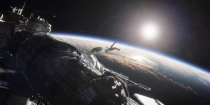
Gravity scene grabGravity is a highly detailed action thriller set in Earth's orbit. Starting with a what should be a routine Hubble Space Telescope repair, the mission ends as events threaten the shuttle and astronauts. The movie spins the lead characters, of which there are two, through a series of attempts to survive in orbit while seeking a way back to Earth.

Afterparty

Afterparty book coverSet in the near future, Afterparty explores a world where psychoactive drugs are printable. All you need is a chemjet printer and an Internet connection to begin printing designer drugs on paper, which is torn up and digested for each hit. The story follows Lyda Rose, one of the five founders of Little Sprout, a group trying to find a cure for schizophrenia, a condition from which Lyda's mother suffered.

The group is successful and Numinous is ready for trials when an event changes their lives. In high enough doses, Numinous permanently alters the user's perception by imprinting a bond with whatever god they believe in, often paired with hallucinations of a holy figure to watch over or even run their lives. Lyda believed the recipe was off the market, but then someone shows up in her ward who is clearly under its effect.

Angered by this, Lyda leaves care early with plans to find the source. With help from a few friends, not all of them real, she goes on a thrilling adventure across Canada and the United States in search of answers.

Using the past to forecast the future

Flying carPredicting the future goes hand-in-hand with preparing for the future, a skill humans have developed to survive tough times and to make their world a better place (mostly, but not always). While we live at a point where futurism is growing more mainstream, even if the term and field are not household names, futurists have made predictions for some time. Ed Fries, formerly of Microsoft, has shared his collection of century old, French futurist postcards in which artists forecast life in 2012.

The postcards depict a variety of scenes, including the one above where a family takes a trip to the moon. Others include a Skype-like system of communication, flying cars, and aquanauts riding seahorses. You can see them at Wired, in an article by Greg Miller.

Pages