Will our future include bread runs to feed our smart-toasters?
 Printer-friendly version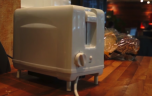
It'll start out that way, of course. We'll buy these networked, AI driven toasters to pop some bread in which they'll char to perfection every time. There will be toast contests with our friends, an app keeping track of how many slices we consume over time and how many steps it takes to burn the calories - more with butter - even more with jam.
Like most things, the toaster will lose its newness. The shine will wear off as the dust collects. Every so often, it'll let us know how unhappy it is. How unused if feels. That's when we start buying bread just to give it something to do, so it will feign happiness and not annoy us with its app notifications - "It's time for some toast!"
Someone invents Almostoast and sells a billion of them to the smart toaster owners. We pop in two "slices" and the toaster hums away, scorching the unscorchable until the ceramic squares pop up, the sides a nice brown to give the toaster little sensors the impression it has done its work before they cool back to a flat white. The next morning, we push the lever again, giving our little toaster a bit of thrill to start the day.
Eventually, the Almostoast wears out, the color-change coating no longer as sensitive to heat. We've set the heat slider to thermonuclear meltdown, but all we get is a singed dust smell out of it. Considering what to do, we pull the slices of Almostoast out and drop them in the trash. A glance back at the toaster and then it follows along, it's node disappearing from the appliance grid forever. Only a small red dot we click once to see we made over a thousand slices of toast with it...except we really didn't. Then we toss the smart blender and the fruit sniffer. We delete their apps and take a long look at the robot. Do we need it? Is it really necessary?
The robot, a newer generation with a heightened context awareness, hurries to the pot, pours us a coffee and says, "You were wonderful last night" as it hands us the mug.
Wired gives us a glimpse of the design project Addicted Products. Awarded Best in Show at the 2014 Interaction Awards, German designer Simone Rebaudengo rewrites how we might see the future to depict a house full of appliances that need to be used. In order to test the idea, he outfitted five toasters with sensors and network access, programming them to track how often the other toasters are doing their job.
Addicted Products: The Story of Brad the Toaster
The author, Kyle Venhemert, gives us two very interesting questions about how the project originated:
What if the smart objects of the future aren’t just smart, but also potentially jealous, petty or vindictive? What if, connected to and benchmarked against their peers, their relationships with each other start to inform their relationships with us?
And this is just a toaster. Imagine if your sexbot is networked...and what they might message about you behind your back.
 Interested in the social impact of our future advancements, Daryl developed and built Regarding Tomorrow as a platform to share and discuss our collective hopes and fears of the future. Daryl's background is in education, including graduate studies in special needs and a masters in instructional technology from UVA's Curry School of Education. He has worked as a high school teacher and has over 10 years of university experience in the US and Canada.