Dear subscriber, you are registered as a participant in a mass disturbance.
This was the content of a text message received by cell phone carrying protestors in Kiev by the Ukranian government. Using mobile technologies, the government was able to identify all of the phones in certain areas and target them with this warning. It's a message that lets the carrier of the phone know they, or the phone owner, has been identified by private records as participating in the protests - or at least being in the vicinity.
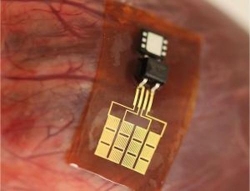
Researchers at the University of Illinois-Champaign have created a new flexible technology, a nanoribbon, that attaches to human organs and is capable of generating electricity as the organ moves. The current technology is focused on providing power for pacemakers so long term use of these devices could require less surgeries and also be less intrusive in the body.
The other half of the breakthrough is the ability to generate up to 8 volts of electricity from a single device embedded in the body, enough energy to power low-energy devices as long as the nanoribbon (and body) continue to function. Looking long-term, this makes it possible to go past the wearables marked into embedded sensors, monitors and even controllers (OH MY!).
Back in November, I posted about Japanese Micro-apartments and how they might offer the feeling of space confinement on long-voyage space vessels. On a happier note, Spanish architecture firm Elii takes a tiny (620 square feet) living space and redesigns it to offer useful elements such as hidden storage, disappearing eating space and maximal sunlight penetration.
Glow is an app for iOS and Android devices designed to assist women (and couples) with tracking and controlling their reproductive health by identifying their activity cycle. Founded by PayPal co-founder Max Levchin, the company offer two ways to help women or couples looking to conceive (or not).
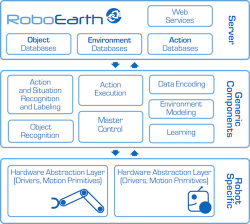
RoboEarth is a project designed to network robots so each can add and pull information from a central repository. By sharing their "experiences", the robots can learn more quickly and access content to help them adapt to each process. The company's website provides this explanation of the online system:
"The RoboEarth Cloud Engine (also called Rapyuta) makes powerful computation available to robots. It allows robots to offload their heavy computation to secure computing environments in the cloud with minimal configuration. The Cloud Engine’s computing environments provide high bandwidth access to the RoboEarth knowledge repository enabling robots to benefit from the experience of other robots."
Usually, lists of interesting pictures do little more than stoke the imagination. That's great, but it's so much better when you can see some interesting ideas that could actually solve real issues. An article on Discovery.com provides a dozen ideas for dealing with rising ocean levels and also creating energy (I assume because land-based energy sources will use too much important above-water property).
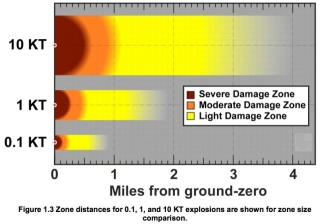
Annalee Newitz of IO9 interviewed Michael Dillon, an atmospheric scientist at the Lawrence Livermore National Laboratory. They focused on Dillon's research about how the government should respond in a disaster scenario where an airborne threat can continue to spread. If you're interested in future scenarios happening after a man-made calamity, this is a great source of information.
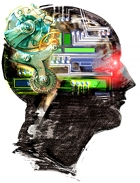
It's a good question and George Dvorsky at IO9 interviews Luke Muehlhauser, Executive Director of the Machine Intelligence Research Institute, discusses his influences and research. I think this quote sums up the importance of his work and why we should all be interested in the expectations for artificial intelligence:
I pretty quickly realized that the intelligence explosion would be the most important event in human history, and that the most important thing I could do would be to help ensure that the intelligence explosion has a positive rather than negative impact — that is, that we end up with a "Friendly" superintelligence rather than an unfriendly or indifferent superintelligence.